Thursday, March 23, 2017

How to be an Ancient Greek Athlete: A Guide to Olympia


1. Arrive at Elis, the city nearest to Olympia, with your trainer ten months prior to the Olympic Games. Remember to register to compete, but only if you are a free, Greek, male citizen. During this time you should be using the local training facilities (gymnasium and plaestra) in order to train for your sport. The following are your options:
  • The Stadion - A 192 meter sprint. The original and most prestigious event.
  • The Diaulos - A 384 meter sprint around a turning post.
  • The Dolichos - An endurance race consisting of 18/24 laps (lap = 192m).
  • The Hoplitodromos - A 192 meter sprint in full armor.
  • Boxing
  • Wrestling
  • Pankratio - A combination of boxing and wrestling. Hand-to-hand combat to the brink of death.
  • Various Equestrian Events - Most expensive sport but available to women.
2. In the month prior to the games, you will make the 30 kilometer procession from Elis to Olympia where you will train using the actual athletic facilities. Before you enter the gymnasium, you must first proceed through the bouleuterion, where you would check in and strip to the nude. Those athletes participating in the running events will practice in the gymnasium (which translates literally to "the naked place"), while combat athletes practice in the plaestra. Also during this first month, heats will be held in order to narrow down the competition for the actual Olympic games. 

Plaestra
3. At the start of the actual games, which last for five days, the athletes will proceed into the Sacred Altis, the religious area of Olympia, where the sacred flame would be lit. Sacrifices would be made on the Altar of Zeus (100 oxen) and you would swear the sacred oath to Zeus. This oath binds you to the rules of the games - no cheating and no bribing - as well as dedicates your performance to the gods.

Altar of Zeus
 4. After giving your oath to Zeus make sure you turn around and look at the Philippeon, which was built by Philip II of Macedonia to celebrate his third Olympic victory in an equestrian competition. Later Alexander (the Great) finished his father's monument and made it into an ancestor shrine, which didn't go over very well with the Greeks...

Philippeon
 5. Proceed past the Temple of Hera, and give sacrifices to her. Her temple was built in 570 B.C. and was the model for the Doric temple structure throughout antiquity. Ladies, don't fret, the Temple of Hera contains inscriptions which tell of an athletic competition held at Olympia for young women. (The altar is also where the modern Olympic torch is lit)

Temple of Hera


6. As you pass the treasuries of the city-states, you will fall into two lines, in which you will proceed through the crypt into the stadium for your competition. Be advised by the statues surrounding you, however. Look to your right and smile, picture yourself erecting a statue here among those who have won twice in the Olympic games, your name inscribed with your victories and athletic prowess for eternity.  Don't become too confident. Those statues of Zeus on your left have been erected by cheaters... it is better to compete fairly and lose, than cheat and win.

Crypt
 7.  You enter the stadium to the roar of 150,000 people who have come from all over the known world to watch you compete. They want competition, they want blood, and most of all they want to see the best Greece has to offer. Make sure to give them a show. After you are announced and your lot has been chosen, line up at the starting blocks, place your toes in the grooves and squat with your arms straight out. When the ropes are released, give a hop and then proceed to run down the track with your elbows and knees making ninety-degree angles. Remember you are only running on the balls of your feet, your heals should never touch the ground.

Running at Olympia
(The girl in black has the best form)

If you are a combat athlete, pray you don't get chosen to compete against Milo of Croton. You will be competing after all of the foot races have been completed. Move to the center of the pit and wait for the judges to call out the start. Stay on your feet and keep your guard up. Wrestling is based on points, the first to three points wins. Points are earned by pinning your opponents back to the ground. Boxing and pankratio are fought until either unconsciousness or death. Putting up your right pointer finger signals your surrender... but it is better to die than surrender.

Stadium at Olympia
 8. Turn and look to your left to the marble seat. Sitting upon it is the Priestess of Demeter, who has a sanctuary at Olympia. She is the only woman allowed at the games. Pre-menstrual girls are allowed to attend with their fathers - potentially to find them a future husband.

Seat of the Priestess of Demeter

9. CONGRATULATIONS!! You came in first place in your sport! Thank goodness because those athletes who come in first place are the only ones who receive the prizes. All of the training you have received since the age of five has paid off and your name will be entered into the records at Olympia. You proceed to the Temple of Zeus and stand in the shadow of the gold and ivory statue of Zeus (one of the Seven Wonders of the Ancient World) to receive your prize... an olive crown. There is no money for you at the Olympic Games, perhaps you will try the PanAthenaic games next if you need the money. Don't worry, upon returning home to your polis you will be showered in prizes, and money, and sponsorships.

Temple of Zeus

Don't get too comfortable in your victory, the Nemean, Isthmian, and Pythian (Delphic) games are coming up, and your competitors are out for blood.

Ancient Messene

After the day in Mystras and Sparta, we stayed the night in Kalamata where I watched a beautiful sunset on the beach.


Harbor of Kalamata

Sunset in Kalamata

The next morning, Friday, my Ancient Sports class again separated from the other groups and traveled to the archeological site of Ancient Messene. Messene was an Ancient Greek polis that was enslaved by Sparta until the end of the Peloponnesian War. After Messene gained its independence from Sparta, it flourished during the Hellenistic Era and became a preeminent city in Greece during the Roman Empire, hosting multiple emperors including Nero, Hadrian, and Marcus Aurelius. Due to the fact that Messene thrived until the Byzantine period, the archeological site boasts Classical, Hellenistic, Roman, and Byzantine architecture, making it a beautiful conglomeration of Greek Culture during Antiquity. My professor previously excavated in Messene, so we were able to interact with the ruins in a more in depth manner, going behind the ropes in order to see some of the ruins not currently on display to the general public.

We started our tour of Messene in the first of three theaters located within Messene, The marble seats of this theater have been reconstructed using only the original materials. The Messenians, when originally constructing their theater, numbered the stones in the quarry to allow for quick construction, which allowed for an accurate modern reconstruction. This theater demonstrates the engineering capabilities in the ancient world as it contained a trap door for special effects and could have been converted into an arena for gladiatorial combat.

Theater of Messene
We then walked through the agora of Messene which housed both a Temple to Artemis and a Temple of Asklepios the Politician. At the temple of Artemis we left monetary offerings, in the same vestibule that was used for offerings during the Hellenistic and Roman period!

Offerings to Artemis

Pretending to be the Statue of Artemis

After the Temple of Artemis we got to see a funerary monument to nine citizens of Messene who died in battle. These nine citizens included three women! THREE WOMEN!! And we even have their names. Not only were these women allowed to fight for their polis but they also have been memorialized in eternity for it. I do not know of any other monuments to warrior women in the Greek world, especially for women who are not leaders of their perspective states. This was absolutely fascinating to see and just made this amazing archeological site even better.

Funerary Monument

We also got to see the reconstruction of a mosaic that was found in a Roman home within the borders of Messene proper. First, the placement of this house is slightly problematic as houses typically were not build within the area of the agora, so the owner of this house may have been a significant member of the community during the Roman period, and may have adapted an established building for his home. The reconstruction of this mosaic is based solely on the tile pieces that were found at the site. These tiles were removed and then reconstructed off site before being placed back on the floor of the house. While the reconstructed mosaic is arbitrary in its design, it does reflect the iconography used in other mosaics of the same time and was carefully created based upon the ratio of different types of tiles. We do know however that the depictions of the pottery in the middle of the mosaic is part of the original design because some of those pieces were found in situ.

Reconstructed Mosaic

Then we went to the stadium of Messene which was absolutely spectacular, and I hate running. Because of the Messenians penchant for labeling their stone blocks, this stadium is one of the best reconstructed stadiums in the Greek world. While we were at the stadium, we were played two team sports phalininda and the Romanized version - harpastum. These two games are similar to a combination of rugby and handball, and although my team lost both games, it was really enjoyable to learn about and subsequently play these two sports in an actual stadium in which they would have been performed. 

Stadium of Messene
Due to the impressive reconstructions and the behind the scenes tour of the archeological site, Messene has been my favorite archaeological site in Greece to visit!


Wednesday, March 15, 2017

Mycenae... Nemea.... Mystras... OH MY!

Every semester, CYA/DIKEMES holds faculty guided field trips to the Peloponnese, Delphi, and Northern Greece, in order to give students the chance to have lessons on site of many of the locations in which we study. The first was a five day trip is to the Peloponnese, Tuesday to Saturday, in which we cover the Eastern and Southern Coast of the Peloponnese.


Tuesday morning we left for the Peloponnese from Athens, and stopped shortly at the Corinthian Canal, where we were able to walk across the bridge connecting "mainland" Greece and the Peloponnese. The canal is four miles long and seventy feet wide at the bottom. From ground level to sea level (at which the canal was cut, removing the need of locks) is 250 feet, and the water depth is 26 feet deep.While the canal was proposed during ancient times, construction of the final canal didn't occur until 1881. Unfortunately, between the time that construction on the canal began and the time that the canal opened, cargo ships radically changed and the canal no longer is able to accommodate the size modern ships. The canal did, however, separate the Peloponnese from the mainland, essentially making it an island.

Corinthian Canal

Our first official stop was to the Bronze Age settlement of Mycenae, which is known for its famous tombs and the legendary hero Agamemnon. Mycenae is the cradle of Greek civilization, dating from 1400 B.C. to 1150 B.C. and is crucial to our understanding of Bronze Age Greece (think Trojan War period). The most exciting aspect of the archeological remains of Mycenae are the giant Tholos tombs, which are bee-hived shaped burial mounds that were built into the existing landscape. The most famous and well preserved of these Tholos tombs is the Treasury of Atreus, which was named by Heinrich Schliemann after the legendary father of Agamemnon and Menelaus. These Tholos tombs combine post and lintel construction with corbel vaulting to create large tombs with haunting acoustics. These are incredible structures of engineering that have (mostly) remained structurally sound for over three thousand years.


Treasury of Atreus

Internal Corbel Vaulting
Mycenae is also known for its fortified citadel, which contains a megaron, or palace complex. The walls of this citadel are called 'Cyclopean" Walls as Ancient Greeks believed that the multiple ton stone blocks could only have been moved by the mythic cyclops. The entrance to the citadel is marked by the famed Lion's Gate, named for its carved relief of two lions (or as my professor liked to call it... The Griffin Door! HA!).

Lion's Gate and the Cyclopean Walls


After touring the citadel complex of Mycenae, we traveled to Nafplio, the first capital of Modern Greece.  Here we were taken on a walking tour of the city, where we got to see the first public school of Modern Greece, as well as the first state building and military garrison. We were even able to see the place in which the first governor of Greece, Ioannis Kapodistrias, was assassinated by political rivals. 
Stray Bullet Holes from the assassination of Kapodistrias

Wednesday, my Sports and Games in the Ancient World class traveled to Ancient Nemea, which has the best preserved stadium in Greece. We were able to take a tour of the stadium structure, from the changing rooms of the plaestra, to the stadium structure itself. For the past month, along with learning the theory of sports in ancient Greece, we have also trained in the running events, particularly the stade (192 meters) and the diaulos (a double stade). This training has included practicing the proper starting technique for the hysplex and balbis (grooved starting block) as well as running with the proper form and stride. At the stadium of Nemea, we were given the chance to race on the actual stadium where athletes competed for glory thousands of years ago. In the races I came in fourth place in my class, which would not have won me the prized celery crown in antiquity, but I am proud of my efforts nonetheless.
Stadium of Ancient Nemea
In the afternoon, we went to Epidaurus, which I had went to earlier in the semester. We were able to go down to the Stadium in Epidaurus, where we compared its structure to the stadium at Nemea (Nemea wins). The most exciting part, however, is that I got to sit in the same seat that Nero, Hadrian, and Marcus Aurelius sat in at the Theater of Epidaurus! My butt touched where their butts touched!! Ahhh.... The thrills of a Classics Major!


On Thursday, we traveled to the fortified Byzantine town of Mystras, where my Byzantine Art and Architecture class was able to see the progression of Byzantine iconography and architecture during the late Byzantine period. The fortified town of Mystras includes multiple monasteries, a palace complex, houses, and a complex sewage and plumbing system. Mystras is one of the best preserved Byzantine cities in Greece, and served a seat of power for the last two Byzantine dynasties - the Palaiologos family and the Kantakouzenos family. At its peak, Mystras was a center of scholarly learning and imperial power that bridged east and west, which is evident in the iconography and architectural styles found within the town. Having just traveled to Istanbul, It was really exciting to see the divergence in Byzantine styles from the capital during the height of Byzantium and a Greek city during the end of the empire. Mystras was a beautiful city filled with examples of the ingenuity and skill of the Byzantines (indoor plumbing) and exemplified the role of Byzantium as the bridge between the West and the East.

Mixed-Style Basilica in Mystras


Sunday, March 5, 2017

30 Things to Do in Istanbul

When I found out that I was studying abroad in Greece, I knew that I wanted to visit Istanbul, the center of the Byzantine Empire. Last Monday, the Greeks celebrated Clean Monday, a national holiday marking the end of Carnival and the beginning of Lent. I took this four day weekend to travel to Istanbul and experience firsthand the city where East and West meet.


1. Visit the Hagia Sophia
Hagia Sophia

The Hagia Sophia is the first thing any visitor to Istanbul should see, as it is the perfect example of the fusion present in Istanbul - East and West, Christian and Muslim. The Hagia Sophia was rebuilt on the site of an earlier version that burned down during the Nika Riots. Emperor Justinian and Empress Theodora undertook an elaborate building project (go see the Little Hagia Sophia, which was built to test the architectural design) that culminated with the Hagia Sophia, or Church of Holy Wisdom. The inside of the building shows the fusion of the original church and the mosque modifications. The apse is decorated both with a mosaic of the Virgin and Christ, as well as with beautiful stain glass from the Ottoman period. Around the church are the giant calligraphic initials of Ottoman Emperors, and the dome is painted in praise to Allah. While in the Hagia Sophia, definitely observe the building from the Empress' seats, see the Viking runic graffiti in the upper gallery, view the mosaics of Byzantine Emperors and Empresses, and make a wish at the wishing column!

2. See the Tombs of the Sultans
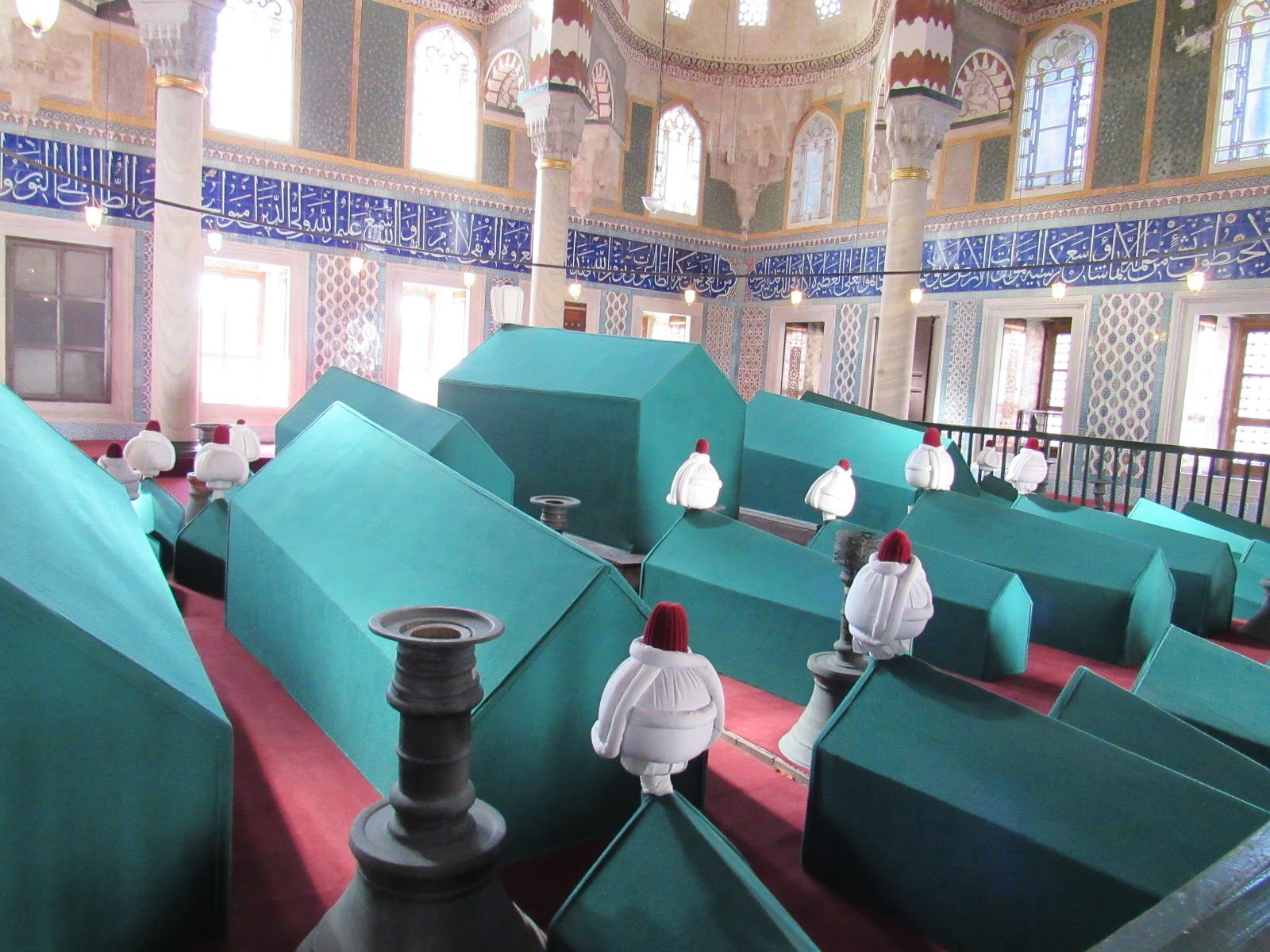
Inside one of the Tombs of the Sultans
The tombs of five Ottoman Sultans and their royal families are located within the Hagia Sophia complex, but are accessed from the outside, and do not charge an entrance fee. While visiting the tombs it is important to remove your shoes and leave them outside of the mausoleums and women should cover their hair in respect for the dead. These mausoleums are octagonal in shape and are domed structures that contain the green shrouded tombs of the Sultan and his extended family. The inside of the mausoleums are just as elaborate as the outside, and are decorated with ceramic tiles and painted calligraphy. The actual bodies lay underneath the floor of the tombs, which are symbolic in nature. The tombs decorated by the white turbans mark the bodies of the Sultan and his sons. 

3. Walk through the Blue Mosque
Blue Mosque

Across from the Hagia Sophia is the Blue Mosque, which was built during the reign of Sultan Ahmet I. The Blue Mosque is named for its blue domes and is still used as a mosque today. Outside of the Blue Mosque are fountains for supplicants to purify themselves before prayer. Tourists are able to enter the courtyard and can enter the mosque through the far entrance. Proper dress code must be observed. Women are asked to cover their hair, while both men and women are expected to wear long pants or skirts. Before you enter the mosque, you must take off your shoes, which can then be placed inside of a plastic bag and carried or stowed on one of the shelves. The Blue Mosque is beautifully decorated with stained-glass, calligraphy, and tiles, and is open to visitors except during times of prayer. While you are at the Mosque, take a free translated copy of the Qur'an and learn about the Islamic religion from its source!

4. Walk along the Hippodrome
Serpentine Column in the Hippodrome

To be honest, I was expecting the remains of the Hippodrome structure to be visible (for that, check out the Hippodrome exhibit in the Museum of Islamic and Ottoman Art). Instead, I got to see a beautiful public square. Located near the Blue Mosque and the Hagia Sophia, the Hippodrome is recognizable by its three columns. The first is the Theodosian Obelisk, imported from Egypt during the reign of Constantine and placed in the Hippodrome during the reign of Theodosius I. The base of this obelisk contains a relief of Emperor Theodosius watching a chariot race in the Hippodrome. The second column is the Serpentine Column that was erected at Delphi in the 5th century B.C. and moved to Constantinople in the 4th century C.E. The head of one of the serpents can be found in the nearby Museum of Archeology. The third column is the Walled Obelisk, or the Column of Constantine VII, who reconstructed the column during his reign. These columns had been used in order to mark the center of the race course. If you are feeling up to it, take a jog around the Hippodrome while you are there.

5. Eat a Doner

doner is the Turkish version of the Greek gyro, and is made with shredded meat cooked on a vertical rotiserie. First, choose from lamb, chicken, or beef, and then watch as they prepare the pita with vegetables, fries, along with other toppings. If you aren't looking for a sit down meal, this is a cheap on-the-go lunch that you can eat while you walk. 

6. Go on an excursion
Walls of Troy VI and Troy VII

If you are visiting Istanbul for more than a couple of days, I suggest taking a day-trip excursion out of the city to see some of the other famous sites of Turkey. I chose to visit the archeological site of Troy, or Truva. This excursion included transport to and from my hostel to the archeological site of Troy (about a five hour journey each way), lunch, and the cost of admission, all for a very reasonable price. While there isn't much left at Troy besides stone structures, it was absolutely amazing to see the site that inspired Western literature, and so much of Greek cultural identity. I was able to see the tomb of Achilles and Patrocles, as well as 5,000 year old fortification structures (which is the oldest architectural structure that I have ever seen.) Due to the lack of recognizable remains I wouldn't suggest the site of Troy for the causal tourist. Instead, I would suggest a day trip to Ephesus or Pergamon for those interested in classical archeological sites, or an excursion to Gallipoli for those interested in modern military history.

7. Visit the Topkai Palace
Wall of Topkapi Palace
The Topkapi Palace structure is located behind the Hagia Sophia, overlooking the Bosphorus, and was the palace complex used by the Ottoman Empire from the 15th century to the 19th century. Having been converted into a museum of the Ottoman royal family, visitors are able to walk through the kitchen area, the library of the Sultans, the circumcision room, as well as the armory. This is the perfect location to see the magnificent tiles and the stained glass produced by the Ottoman Empire. Make sure you dedicate at least a half day to the Palace so that you can view the extensive collection of holy artifacts belong to the Abrahamic Prophets, the collection of clocks, and the portrait gallery. The Topkapi Palace is a must-see on any trip to Istanbul as it serves to transport visitors back to the height of the Ottoman empire. 

8. See the Harem
Receiving Room of the Valide Sultan
The Harem is an extra entrance fee within Topkapi palace, but I think it is definitely worth seeing. The Harem is the collection of rooms and courtyards used by the women of the Ottoman royal family, including wives, daughters, sisters, and mothers. The Harem is also the place in which the education of the crown princes occurred. While touring the harem, you will see multiple sitting rooms for entertainment, as well as private residences. These elaborate rooms show the wealth of the Ottoman Empire, as well as the importance of these women in court. Don't be fooled by the common misconceptions about harems, from the 18th century forwards these imperial women had a significant role in the court - influencing policy and managing the palace. 

9. Enter the Hagia Eirene
Hagia Eirene
The Hagia Eirene often gets by-passed for it more famous neighbor, the Hagia Sophia, but if you have a museum pass for Istanbul, you should take ten minutes and see the Hagia Eirene. The Hagia Eirene, or the Church of Holy Peace, is located within the Topkapi Palace complex. While the inside of the church is nowhere as grand as the Hagia Sophia. the Hagia Eirene is one of the best examples of iconoclasm within the city. Located in the apse of the church is a giant mosaic of a cross, which is believed to have replaced a depiction of Christ during the time of iconoclasm. The Hagia Eirene is unique, as it was never converted into a mosque upon the Ottoman capture of Constantinople. As a result, the Hagia Eirene gives visitors an important look into Byzantine churches.

10. Go to the Museum of Islamic and Ottoman Art

Located right near the Hippodrome, the Museum of Islamic and Ottoman Art is a great way to spend a rainy morning or learn about the evolution of art from the early Arab Muslim dynasties to the emergence of the Ottoman empire. This museum is a little sparse, but contains amazing examples of early Qur'ans, pottery, carpets and kilms, as well as displays of hair from the beard of the Prophet Muhammad. This museum is one of my favorite in regards to its organization, as the museum directs you through the exhibits chronologically. Make sure you finish your visit with a great picture of the Blue Mosque taken from the courtyard of the museum.

11. Walk through the Archeology Museum

After the Topkapi palace, check out the Archeology Museum, a three building museum displaying the best archeological finds of Turkey and the neighboring regions. Make sure you check out the decorations of the Ishtar gate, and the display of the first diplomatic treaty, which occurred between New Kingdom Egypt and the Hittite Kingdom. Also see the famous head of Sapphos and the Alexander Sarcophagus. This museum displays a lot of artifacts that you will not see on display in America or Western Europe, and is a must visit while in Istanbul. This is also a great place to interact with the local "stray" cat population.

12. Descend into the Basilica Cistern
Weeping Column

The Basilica Cistern was surprisingly my favorite part of my trip and perhaps is one of the best hidden gems Istanbul has. The Basilica Cistern was built by the Byzantine Emperor Justinian during the 6th century C.E. The cistern is 140 meter by 70 meters, and contains over 300 columns that had been reused from other monuments. As a result, the Basilica is a museum of different styles of antique columns, which support the weight of the ceiling through arches. The Basilica Cistern can hold over 100,000 tons of water, the largest cistern in Istanbul. Today, water still drips from the ceiling creating echos of splashing water, while Turkish music hums softly in the background. While walking through the cistern, you begin to hear noises all around you created from the echos. The cistern is the home to fish, who swim through the water collected in the cistern. Among the different types of columns, three particularly stand out. Two columns are supported by giant sculptural heads of Medusa, while the third "weeping" column has tear-drop shaped embellishments that "weep" with streaming water. The cistern is nothing at all like I expected and truly is able to transports visitors back in time with its seemingly endless rows of columns.

Medusa Column


13. Take a stroll through Gulhane Park

Formerly part of the Topkapi palace complex, Gulhane Park is oldest and largest public park in Istanbul. A beautiful way to see the outside of the Topkapi Palace and the coastline of Istanbul is by walking through this beautiful park. With its bright green grass, multiple walking paths, and interactive art, people of all ages will enjoy the park. The park is surrounded by the walls of Constantinople and small cafes. The park also features the Museum of the Science and Technology in Islam. The park is a great place to enjoy a picnic lunch or to get away from the bustle of Istanbul. Don't miss the Goth's Column dating back to the early days of Byzantium. which celebrates victory over the Gothic people.

14. Drink ayran
Ayran

Ayran is the national drink of Turkey. Visitors of Turkey, however, either love the drink or hate it. Ayran  is made of thinned yogurt and salt, and is often drunk with lunch or dinner. If you don't like plain yogurt, you probably will not be a fan. I don't think that ayran will ever be a drink that I enjoy, but I am glad that I was able to try the beverage while in Istanbul.

15. Cross the Galata Bridge

The Galata Bridge separates the two parts of Istanbul that are divided by the Golden Horn. This is the first of two bridges, and can be crossed by car or the metro, but is best to do on foot. The Galata Bridge serves as the perfect location for a picture of the Bosphorus or the skyline of Istanbul. While crossing the bridge be sure to check out the fishermen who are fishing off the bridge. You might even see a catch! From the Galata Bridge, you can make your way to the Galata Tower or over to the Asian side of Istanbul.

16. Climb the Galata Tower
Galata Tower
The Galata Tower was built in the 14th century C.E. by the Genosese occupation of Constantinople. During the Ottoman Period, the tower, the tallest in Istanbul, was used to spot fires in the city. Today, the tower sits on top of a steep hill and is surrounded by cafes and intellectual conversations. After braving the long line and paying an entrance fee (25 Turkish Lyra or 9 USD) you are taken by elevator up to the observation deck of the nine story tower. Walk around the observation deck and snap pictures of the skyline. If you get to the tower to watch the sunset, you can stay and eat dinner in the seventh floor restaurant!

17. Cross over the Bosphorus into Asia

There is so much to do on the European side of Istanbul that most tourist never even visit the Asian side. If you have the time, definitely take a ferry to the Asian side of Istanbul, especially if you have never been to Asia before. With less tourists, the Asian part of Istanbul has a more local feel. While you are there, make the trip up Camilca Hill, the highest hill of Istanbul.

18. Sample Turkish Delight

I now understand why Edmund would be willing to betray his family for Turkish Delight in The Lion, The Witch, and the Wardrobe. Turkish Delight, or lokum in Turkish, is a gummy sweet that originates from Turkey. Walk down any street in Istanbul and you will find multiple shops selling the dessert. Sample the different flavors first - mint, rosewater, lemon, or orange - before you buy. Skip the prepackaged sugared lokum because the sugar coating drys out the candy. My favorite was the pomegranate lokum with pistachios and dried cranberries. Most stores can also seal your package of Turkish delight, so they make the perfect gift! 

19. Start your day with a trip to the Hamam
Outside Entrance of the Cemberlitas Hamami

Turkish baths are world renown and a visit to a bath is the perfect way to start your day. I chose the Cemberlitas Hamami, which was built by the Architect Sinan in 1587, because he was the architect for Suleiman the Magnificent, my favorite Ottoman Sultan. Upon entering the bath, you choose the service that you would like to receive (I chose the traditional service) and are separated by gender. After changing into the provided undergarments, you are brought to the hot room, where you lay on a convex stone platform. The humid air opens your pores and makes you sweat. After laying on the stone, an attendant enters and proceeds to scrap off your dead skin, wash your body with soap, and give you a fifteen minute massage. Afterwards you are splashed with water and your hair is washed by the attendant. After being thoroughly rinsed with bowls of warm water, the attendant retires from the room and you return to the stone dome where you are able to rest for however long you want until you wish to leave. The hamam was one of my favorite experiences in Istanbul as it is such a fundamental aspect of Ottoman and Turkish culture. Going early in the morning is a great way to start your day and gives you more privacy during your bathing experience. 

20. Barter in the Grand Bazaar
Gate of the Grand Bazaar
The Grand Bazaar is a must see for any visitor to Istanbul. The Grand Bazaar was built in the late 15th century C.E. and is often considered the oldest shopping mall in the world. With over 61 streets, this covered market contains more than 3,000 shops. Here you will find shops upon shops of leather goods, ceramics, glass, carpets, lamps, sliver ware, along with almost anything else that you could imagine. It is really easy to get lost within the bazaar, and I found all of the people and vendors to be an overwhelming experience, but it is definitely worth walking through. This is a great place to find Turkish carpet or a Turkish lamp, and if you do plan on buying anything within the Grand Bazaar make sure that you barter. Start by offering half of the original price, and slowly raise your offering price. You are not insulting the vendors, who purposefully raise their prices. If you don't feel comfortable with the price, feel free to leave and try another store.

21. Peruse the Old Book Bazaar
Entrance to the Old Book Bazaar
The Old Book Bazaar, located between the Grand Bazaar and Sultan Beyazit Mosque, is another hidden treasure of Istanbul. This street has been a book market since Byzantine times, and carries on that legacy today. After walking through the Grand Bazaar, stroll through this street and look at the secondhand books that the vendors have on display. The Bazaar has something for everyone - from Classics, to English fictions, to historical novels, and biographies - this is a book-lovers dream. My favorite vendor took old and damaged Ottoman manuscripts and painted Ottoman styled art on the pages. This vendor was so passionate and loved showing me all of his wares as well as explaining his artistic process. Here I was able to decompress after the chaos of the Grand Bazaar and hold a page from a 15th century Ottoman manuscript!

22. Try dondurma

Caramel Dondurma in front of the Hagia Sophia

Dondurma means "freezing" in Turkish and is the ice cream of Turkey. Dondurma is made with a flour derived from the root of the early purple orchid and with mastic, a natural resin. These extra ingredients lend to the unique texture of the ice cream, which is gritty, stringy, and chewy. Dondurma is made in a variety of different flavours - I had caramel - and is often sold by street vendors. Looking to try some dondurma? Look out of the long metal paddle and the traditional dress of the dondurma vendors.


23. Visit the Mosque of Suleiman the Magnificent
Inside of the Mosque of Suleiman the Magnificent
This architectural masterpiece was created by Mimar Sinan (his pupils built the Taj Mahal), on behalf of the Sultan Suleiman the Magnificent between 1550 and 1557. This mosque combines Ottoman and Byzantine designs in order to create this spectacular building of prayer. Like most mosques in Istanbul, there is no entrance fee and inside are free informational brochures about Islam and often misunderstood parts of Islamic culture. While visiting this mosque, make sure you remove you shoes and that you are wearing the appropriate clothes. Pictures without flash are allowed and talking must be kept at a whisper. After looking at the mosque, walk around the complex and see the tombs of Sinan, the Ottoman Sultan Suleiman, and the Sultana Roxelana. If possible, don't visit on a Monday, as the tombs are closed (which was the mistake that I made.)

24. Walk through the Spice Market
Spice Market Vendor
The Spice Market is another covered bazaar that contains shops selling nuts, fruits, teas, spices, and sweets. Located next to the New Mosque, the Spice Bazaar is the perfect place to experience all of the flavors that Istanbul has to offer. While the locals use it for weekly shopping, the Spice Bazaar is just as populated by tourists looking to bring home the tastes of the city.

25. Try Turkish Apple Tea
Apple Tea 
While you are in Istanbul you will definitely be offered some tea. While shopping, vendors will offer you tea while you peruse their goods. This is basic Turkish hospitality and does not mean that you are required to buy their goods. If you have the time, you should definitely accept the tea, which will be served to you in a tulip shaped glass. If given the choice between Turkish Tea and Apple Tea, definitely go for the Apple. This is by-far the best tea I have ever tasted in my life. While you are in the Spice Market, pick up some bagged or loose leaf Apple tea to bring home with you.
  26. Eat Turkish Baklava

A point of contention between the Turks and the Greeks is who created their similar cuisines first. While both cultures revere baklava, it is worth trying Turkish baklava while in Istanbul. While Greek baklava is traditionally made in triangles or squares, Turkish baklava comes in circles of wrapped phyllo dough with pistachios in the middle. The Turks also leave the honey to Greek baklava, and use a sugar-based paste. Turkish baklava is perfect with a cup of Turkish tea, or to eat while strolling the streets of Istanbul.

27. Try the Turkish Pide

The pide is the Turkish take on the calzone, which can often be grabbed for a quick lunch! The flat bread is cooked in a stone oven and is filled with the stuffings of your choice - cheese, meat, and vegtables. The pide is a filling meal and is a great choice for a late lunch/ early dinner.

28. Find the Column of Constantine
Column of Contantine

Pay homage to the founder of Constantinople, Constantine the Great, by visiting his porphyry column located right next to the Atik Ali Mosque. The column was dedicated in 330 C.E. in honor of the capital of the Roman Empire moving from Rome to the city founded by Constantine. In antiquity, the column would have held a statue of  Constantine, who was depicted in the image of Apollo. Today, the column is a World Heritage Site and is one of the best monuments of early Byzantium.

29. Buy a Turkish Lamp or Carpet
Turkish Lamps
Turkey is known for its lamps and its carpets, and these traditional items are great mementos for your trip to Istanbul. Both of these items can be bought in multiple sizes and designs, so look around for the one that catches your eye. While these can be bought at the Grand Bazaar, I suggest looking at shops outside of the covered market, who might be willing to give you a better price for a better quality item. Make sure you barter with the vendors, and consider the currency exchange when purchasing one of these items. I, myself, am a proud new owner of a Turkish Lamp.

30. Listen to the call of prayers between the Hagia Sophia and the Blue Mosque
Hagia Sophia during the Call of Prayer
The call of prayer (ezan) can be heard six times a day in Istanbul - early in the morning, throughout the day, and late at night. One of the most beautiful call of prayers is between the Hagia Sophia and the Blue Mosque, where one muezzin sings out one part of the ezan from one minaret, and another responds from a second minaret. Non-Muslim visitors should not enter the mosques during the times of prayer, so this is the perfect time to grab something to eat and sit down to listen to this beautiful practice.

Thursday, February 23, 2017

Crash Course to Athens


As of today I have been in Athens for a month, and I have enjoyed every minute of it! Athens has provided me with a safe home in which I can grow as a person. Athens, and much of Greece, is a bastion of Western culture, yet many aspects of everyday Athenian life are unique.  Looking back on my first month in Athens I have compiled a list of cultural quirks and tips for navigating this timeless city.

1. DON'T EAT THE "ORANGES"

Strolling down the streets of Athens, one cannot help noticing the mulberry and orange trees. On a warm Athenian day (which is most days) one might get the urge to quench their thirst with one of these accessible oranges. Don't. This masquerading oranges are actually vεραντζάκι, a bitter-cousin of the orange we all know and love. These trees aren't without purpose though, they are hardy trees that can survive the "cold" Athenian winters, and they serve as a natural way to perfume the city, especially when the summer heat begins to creep in. The Athenian people don't let the bitter fruit go to waste. Instead the fruit is harvested and uses to create sweets and to flavor alcohol. So please don't eat from these trees, instead stop in the local bakery and pick up some of the candy made from the vεραντζάκι, it is much more pleasing to the palette. 

2. MIND THE PLUMBING


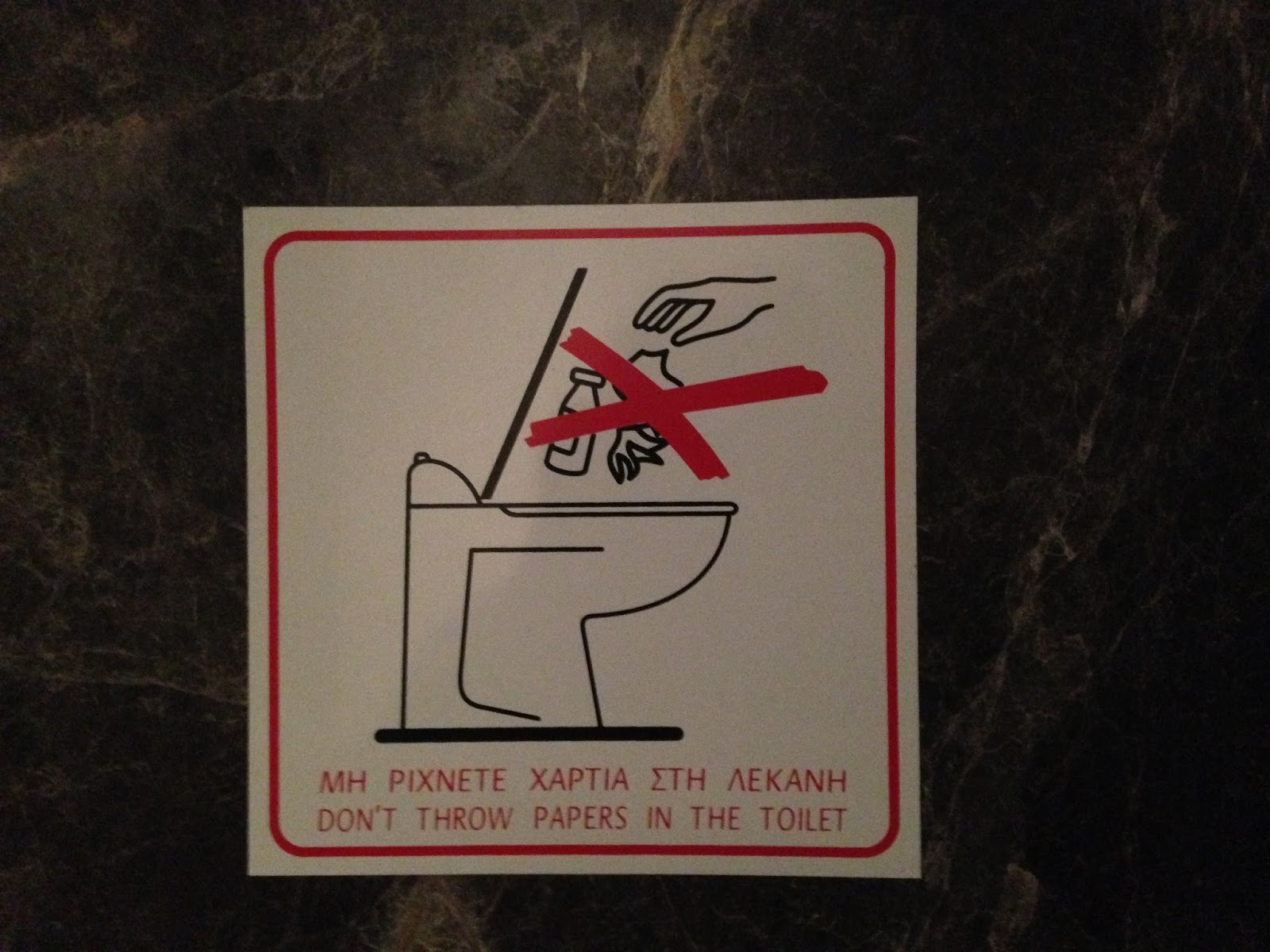
Due to the fact that America is a relatively newly developed country, most of the plumbing and sewers are able to accommodate larger volumes of waste. Athenian plumbing, however, is hundreds of years old and because many Athenian buildings are made out of concrete, as a method of fire prevention, many pipes cannot handle large volumes of waste. As a result, Athenians do not flush toilet paper down the toilet. This was one of the most difficult aspects of Greek culture to become accustomed to and most other members of my study abroad program agree. Athenians, and most Greeks, dispose of their used toilet paper in the bathroom (which is apparently called a water closet) garbage can. This also means that you have to take out the garbage often. The first couple of weeks in Greece I would accidentally forget to throw the toilet paper out and flush instead (and occasionally at three in the morning, when I am half asleep, this still happens), one time isn't going to break the plumbing, but unless you want to cause a plumbing backup through the entire building, it is best to abide by this practice.  

3. PEDESTRIANS DO NOT HAVE THE RIGHT-OF-WAY

Coming from a state in which pedestrians always have the right-of-way, not even Boston traffic could prepare me for the danger that is Athenian traffic. First, I have yet to see a speed limit sign off of the highway. Second, Athenian drivers do not stop for pedestrians. On most roads where there is a designated pedestrian crossing, the oncoming traffic is given a yellow yield light during the duration of the green walk signal. In America this would signal to drivers that they could proceed as long as there are no pedestrians present, this however is not the case in Athens. While crossing during a green walk signal, I have been honked at, swerved around, and almost run over multiple times. The most baffling sight for me was traffic coming to a complete standstill, during a green light, for a stray dog to cross the street not minutes after I had been honked at for crossing the street during the allotted time. I think that tells you something about the Athenians. Crossing the street in Athens means taking your life into your own hands, but there is so much to see in this remarkable city, so just make sure you look both ways... and walk quickly.

4. STRAY ANIMALS


Athenians love their animals. Athens is abound with stray animal - primarily dogs and cats. In fact, it is almost impossible to walk more than a block without seeing a cat walking around or a dog laying in the sun. These strays are friendly, especially if you have food, and are more than willingly to be the recipient of your affection. Though they are approachable, please respect the animals. If you do want to say "hi" make sure you approach slowly with your hand outstretched for them to smell before you attempt to pet them. Some of the animals are skittish and if the animal retreats or growls, leave them be. My favorite stray animals are the ones who live in the ancient sanctuaries and monuments, as if they are serving as the sanctuary's guard, perhaps even as a reincarnation of a soul who visited the sight two thousand years prior. The Athenians also have a wonderful custom of bringing their pets to work. Don't be surprised if you walk past a shop and a small dog or cat is sitting in the doorway, or if their are dogs laying beside their owners at sanctuary entrances. There is no need to be alarmed, Athenian pets are extremely well behaved and are often walked without leashes (think about how well behaved they need to be with how dangerous traffic is). 

5. LEARN YOUR COFFEE ORDER 

Quoting one of my professors, "the only thing Greeks love more than backgammon and cigarettes are their coffee." One of the few industries that has thrived since the financial crisis is the cafe, and most streets have at least three cafes available for you to choose from. If you come to Athens, or anywhere in Greece, one of the first things you should do is learn your coffee order in Greek. Greek coffee shops are a center of Greek culture and one of the better places to meet the local people. Don't worry about perfect pronunciation, the Greeks understand that their language is difficult, especially for Romance/Germanic language-speaking people, and even attempting a few words will thrill them. Learn how to say hello, please, thank you, and sorry. The quickest way to a Greek's heart is through their language or their coffee. So when you stop and visit the cafe, order in Greek and don't forget to order a τυρóπιτα

6. VALIDATE YOUR TICKETS

The Athenian metro/bus/tram system runs on the integrity of the passengers. Tickets can be purchased in the metro stations or at kiosks  and once validated are good for ninety minutes. Due to the fact that metros stations do not have turnstiles or automatic barriers it would not be difficult to board the metro without validating (or buying) a ticket. Do not do this. Often their will be metro authorities who will check ticket validity (especially on the weekends) at the exits of the metro. The penalty for not validating your ticket - you have to pay 60x the original price of the ticket in fines. A generic metro/bus/tram ticket is 1.40 euros and a ticket to the airport is 10 euros. Those are significant fees for not validating your ticket. Thankfully, the Athenian public transportation system is getting a makeover in 2017 by converting to plastic cards (think Boston's Charliecard or the London metro card) as well as automated gates.

7. STOP AND LOOK AT THE GRAFFITI


It may be shocking for Americans to see the large amounts of graffiti that covers the surfaces of Athenian buildings - from apartment buildings to shop fronts. Most Athenian's however are not offended by the presence of graffiti, and instead see it as a productive means for dissatisfied citizens to express their opinions. Graffiti is often used by young people to express their dissatisfaction with the government or certain policies and to express their opinions on world events. Yes, some graffiti marks "gang" territory and others are works of art, but most are insightful and cultured discussions of current events. Once you learn some Greek you will see comments on the refugee crisis, the rise of the neo-Nazi party in Europe, and the economic crisis. The anarchist party in Athens is particularly prolific in their use of graffiti and their work will often be tagged by the anarchist "A." Visitors to Athens may even be surprised to the large number of graffiti that is written in English, which might be used by younger people to establish credibility and mark worldliness through their knowledge of a foreign language. There is a hard limit to the graffiti however. Greeks are adamantly against defacing ancient monuments, temples, and sanctuaries, and even older sections of Athens, such as Plaka, have significantly less graffiti present than more modern neighborhoods. When you are walking around Athens take a moment to stop and look at the graffiti. If you don't know what it says, feel free to take a picture and ask the barista at your cafe to help you with the translation, they will be excited that you are taking an interest in the social and political climate of Greece.

8. Σιγά, Σιγά


Americans walk fast. In fact, one of the biggest tells that you are a foreigner is how fast you walk. The unofficial Greek motto is Σιγά, Σιγά - slowly, slowly - which is often difficult for a foreigner to get used to. Athenians will stroll from place to place, picking up a coffee along the way, stopping and talking to friends, and enjoying the Athenian sun. If you are in Athens, put aside your desire to rush from place to place, and do as the Athenians do. Take the time to enjoy your surroundings, look up and look down. Athens has so much for you to see that you will inevitably miss if you are rushing back and forth. The Greek motto is extended to their afternoon siestas, which become a necessity during the hot summer months. In Greece, siesta is law, and you will find that many business will shut down from two to five in order to observe this. Take this time to enjoy this Greek tradition and head back to your room for a quick power nap, but remember to be quiet in apartments and hotels as not to disturb others who may be resting. Due to siesta, many business hours will not be familiar to Americans, many small, independent stores and pharmacies follow schedules similar to the one posted above. On Mondays and Wednesdays they will close for the day at two in the afternoon and on Tuesday, Thursday, and Friday, they will reopen following siesta. This resting period also means that dinner is often observed later in the evening, so do not be surprised to see Greeks enjoying dinner around 10 p.m. and visiting bars beginning at 1 a.m.. Greeks may proceed slowly through their day, but they still get everything done.

9. HAND GESTURES 

In America, when crossing the road, I will often times raise my hand in order to thank the driver for letting me pass. This is an insult in Greece, and may get you run over (this might be an exaggeration, I have yet to find out). To the Greeks, an open hand with the palms facing out, is the sign of the "evil eye" (think Italy) and is seen as a curse (think middle finger). Show your respect to Greek culture by not directing your open palm at someone, especially a stranger. If you want to say "hi" to a Greek, you may use an open palm, but make sure you wave it side to side. In order to get someones attention, or answer a question in class, signal with only your pointer finger raised. Trying to signify the number five? Turn your open palm towards yourself. Dismay or excitement is express through rotating your hand near your temple (again, your palm faces towards you), the speed of the rotation signals the emotion - fast for excitement, slow for dismay. Don't want to accidentally be cursed? Pick up a little blue-eye glass charm in Plaka to ward off any potential evil.

10. DON'T BE INSULTED

The Greeks are very honest, open, and curious people. As a result you may find a stranger coming up to you and asking you where you are from and why you are in Greece. Trying not to feel uncomfortable, they are simply curious and want to share their culture with you. Many taboo questions in the United States are acceptable in Greece, including asking your age, your salary, your relationship status, and who you voted for in the last election. These questions are innocuous in Greece and often result from the desire to get to know you better as a person. Greek people are also known to stare, this isn't aggressive, again, it is just a manifestation of their curiosity, especially if you are speaking English! Also if you are trying to show off your Greek language skills, don't be surprised if Athenians begin to speak in English with you after your first attempt. Most are really excited that you attempted to speak their language and now want to practice (and show off) their English with you! As a student of ancient Greek culture, the history of Athens is definitely a draw, but to be honest, you should really come to Greece to meet the people. I have never met a more caring and welcoming people in my life. I have had a stranger who helped me through the Greek Post Office system give me his name and number in case I ever had an emergency and needed help while in Athens. I have also had a vendor at the local farmer's market give to me two lemons without having me pay because I attempted to ask for them in Greek. Despite the economic struggles that the Athenians face, they will always take the time to share their city and their culture with you.