Wednesday, April 22, 2020

Peloponnese Field Trip (Day 2): A Town of Past Glory and the Air of Olives


Day two of the Peloponnese field trip! We started off our day by going to the Fortress of Palamidi in the town of Nafplio. Its position on top of a high hill gives it spectacular views of the city and the ocean. Professor Dimitri gave us a brief history of the fortress then showed us the dungeon where a prisoner would serve solitary. We all filed in one by one, having to crouch down and waddle through a tunnel, to get to the small dungeon. Our group decided to walk the 913 steps from the fortress down to the road where our bus was waiting. My shins were aching but the views were so worth it!
Walking the 913 steps down!

My friend Danielle and I on the balcony our room with the Fortress in the distance!

A video of my group walking into the solitary dungeon!

Our next stop was the Archaeological Site of Mystras, the center of Byzantine power. The site was beautiful and probably the largest archaeological site I’ve ever seen. A CYA professor, whose expertise is the Byzantine era, gave us a tour of the three-leveled ancient town within the fortifications and including houses, streets, public squares, churches, and palaces. We could see evidence of the town’s Medieval and Ottoman history in the same place!


A beautiful church on the site!


Walking through the streets of Mystras!


For lunch, we stopped at the modern town of Sparta. I was super excited to see Sparta because it has always played such an important in mythology and ancient history. The Spartans were known for their military prowess and societal order. They prided themselves on being the opposite of democratic Athens; there was a very clear hierarchical structure, and everyone knew their roles and what they were supposed to do. They were the superpower of ancient Greece. Modern Sparta, however, did not reflect this. Perhaps it was because we didn’t have enough time to explore or we visited during the wrong time of year, but the city did not show hints of its legendary past.

Our last stop was the city of Kalamata, where we spent the night. For one of my classes, “Ancient Materials and Technologies”, my group had chosen the name “Kalamata Olives” for our team name (don’t ask). I knew Kalamata was famous for their olives, but what I wasn’t prepared for was to be hit with the smell as soon as I stepped off the bus. We didn’t have much time to explore that night, but we were just in time to catch the sunset at the port to the smell of olives ahh ~~

Sunset with a smell of olives! :)

Saturday, April 18, 2020

Peloponnese Field Trip (Day 1): A Land of Mythology and some ~Authentic~ Gelato

Peloponnese Field Trip!! Day 1!!

Day one of our whole program Peloponnese field trip! I’m super excited about this trip. The Peloponnese played such an influential part in the shaping and identity of Ancient Greek history. As a classical studies major, I’m most excited about visiting all the sites associated with mythology!!!

We have all been split into 6 different groups with different focuses. My group’s theme is “The Shaping of Identities”. We will explore the importance and role of fortified locations in shaping and protecting the character, independence, and survival of the Peloponnese and its people.

We set off at 8am sharp from CYA and made a stop at the Isthmus of Corinth. Apparently, the word “isthmus” comes from the Ancient Greek word for “neck” and refers to the narrow strip of land that connects the Peloponnese to mainland Greece. We all stopped on the bridge to look down into the canal that cuts across the land, connecting the Gulf of Corinth with the Saronic Gulf. The canal now is an incredible sight—the land drops straight down hundreds of feet and standing on the bridge, you can see both ends of the narrow canal. It’s crazy to think that throughout ancient Greek history, so many attempts were made to dig this canal by hand.

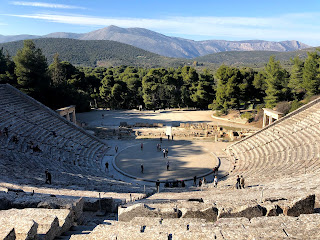
Our next stop was the archaeological site of Mycenae where we saw the infamous Lion’s Gate and Grave Circle A where the Mask of Agamemnon was discovered. Standing at the Lion’s Gate, we got to see the fortification wall that enclosed the main portion of the city. The wall is 6 feet thick and built from huge limestone blocks fitted together. They’re called “cyclopean walls” because Ancient Greeks (after the Myceneans) believed they were built by cyclops. Something our group discussed was the purpose of the walls. They were unnecessarily thick and there is no evidence that contemporary Minoans on the island of Crete had fortifications enclosing their cities. Our conclusion was that the thickness of the walls was to send a message to other Mycenean cities of their power. We also got to go to the Epidaurus theater!! We took turns standing in the middle of the theater to test out the acoustics. A man came up and started singing opera while we were there!

The Mycenean Cyclopean Wall


Ancient Theater of Epidaurus

The Lion's Gate

 
We also visited the archaeological site of Epidaurus. Our group leader, Professor Demetrios, led us through the sanctuary of Asclepios on the route that an Ancient Greek visitor would have taken. Before entering, a visitor would cleanse themself in order not to pollute the sanctuary. Upon entering, they would make a sacrifice to Asclepios at the temple. The sick would head to the Enkoimeterion where they would sleep and receive a dream from the god with instructions on to heal themselves. What was cool to see was that the sick weren’t the only ones to visit the sanctuary. It included sources of entertainment like a music hall, stadium, baths, and a boxing/wrestling courtyard for other visitors.

Apparently, the! best! gelato!
We spent the night in the beautiful port town of Nafplio, the first capital of the independent Greek state. Apparently, Nafplio has the best gelato so, of course, Professor Dimitri had to treat us all to some! Our group sat on the port and watched the sun set over the ocean. The views are breathtaking!!!!

Sunset at Nafplio!

Friday, December 28, 2018

Farewell For Now

Back home in the United States, I've been thinking about my time in Greece a lot.  Of course, family and friends have wanted to know every detail of my time abroad, and in many conversations I've found myself pulling a blank on what to tell them.  It seems like even though I was in Greece for so many months I don't remember most of it.  After being there for four months, everything that stands out becomes familiar, everything that sets it apart from the US becomes the norm.  And I've noticed and learned about different modes of life, different ways of going about a day, and different ways of interacting with another person.

CYA offered me an invaluable opportunity in many forms: I learned from some of the most incredible professors, all very impressive in their fields.  All of my professors from this past semester were not only excellent teachers, but they were also eager to learn alongside me and my peers as we discovered new finds throughout Athens and the rest of the world.  The friends that I made inside and outside the classroom are some of the best I've ever had.  I know that there are a handful of people I've met here that I will stay in contact with because we've shared this unique experience.  My internship with the MediaLab taught me a slew of professional skills that I will no doubt bring to my next job, and I made more amazing workplace friends along the way.  Even though it was an internship, the responsibility and the respect involved made the position feel like a real job, a real career, and that is a feeling that I will keep with me as I finish school and start to enter the work force as a graduate.

As a whole, Greece was one of the most beautiful places I had ever had the pleasure of living in.  I learned to appreciate the outdoors and the casual din of the people around me.  I learned to listen to the city and look at the corners in new ways. I learned more than I ever thought I would about history purely by looking at one storefront; furthermore, the way Athens is built layer upon layer made me think about my carbon footprint, and the impact I have on the environment on a young person in America.  This city made me think about how I move through the world, and it caused me to think critically of myself and those around me.

One of the best memories I have of Greece, is one that occurred on my last day but brought me back to my first day.  I was walking to the academic center the first day I arrived in Athens, and I needed help unlocking my apartment door.  Having walked to the academic center one way, I thought that the person helping me would walk bak that way with me.  I then found out that there was another, seemingly more confusing way to my apartment.  She took me through winding streets and up and down crosswalks, and looking around I was completely confused and didn't have any of my bearings.  Before heading off to the Athens airport for the last time, I realized that the very same street that I traversed at some point throughout every day was the same street that the CYA employee had led me through on my first day in Greece.  It was a crazy realization to try and see the streets and all its storefronts and people without knowing all the history and experiences I've had with them–it was a surreal experience.  It was then that I realized how much I needed to come back to Greece, whether it's in this decade or the next.  Because the people in Athens knew me, and they helped me to discover who I was and wanted to be in this world.  So, it's a goodbye for now, and a very very large see you soon.

Saturday, December 1, 2018

Hiking Up to the Gods

This semester I had the amazing opportunity to go hiking in the southern part of Greece. About thirty CYA students and a hiking guide from the area woke up early on a Friday morning, to take a six-hour bus ride. Groggily pushing ourselves onto the bus having forgotten to eat breakfast, we all used that morning ride to sleep a bit more and to mentally prepare ourselves to hike up the tallest mountain in Greece –which, of course, happens to be the one and only Mount Olympus
The minute the email about hiking Mount Olympus came into my inbox a few months ago, I jumped at the opportunity to sign up. My mom can attest to the fact that I had barely read the whole email before I was screaming with joy – how often was I going to get the chance to hike up to the mythological throne room of the gods? I knew that having chosen to come to Greece, I absolutely HAD to be on this trip, especially as I had spent the entire summer before thinking about all the possible experiences I could have on that mountain. Now that I’m back at sea level, I can say that the actual hike was nothing like I had expected, but it was still one of the most incredible experiences I’ve ever had.
We started the hike at the base of the mountain, which is in the town of Litochoro. Getting off the bus, I could already tell I would be in for a treat from the beautiful forest surrounding the mountain range. Going to school in Boston, I’ve come to love watching the leaves change, and I was really bummed that I wouldn’t get to experience that while I was in Greece this semester. But it seems like the gods had other ideas because the trees on this mountain range were some of the most beautiful shades of orange, red, and yellow that I’ve ever seen. A lot of the friends I’ve made here at CYA also go to school on the East Coast, and we were spinning in circles for a solid five minutes because we were so excited about the foliage – it was one of the funniest situations ever!

After we calmed down from the surprise of the trees, we started our hike by walking across a bridge that overlooked a small waterfall and then we continued up some steps laid into the path. Within the first couple of hours we made an impressive gain in elevation, and within the first hour I was sweating but still having a fun time. It was incredible to see all the little hills and valleys, and it was really nice to be out in nature. I’m also someone who loves to talk as I’m doing something, whether it’s walking, driving, or doing arts and crafts, and the hike was a perfect backdrop for me. There were a lot of other hikers that I either hadn’t met or hadn’t had a lot of opportunities to interact with during the semester, and I got to meet a lot of new and really cool people that way.
We started our hike pretty late in the afternoon, around five pm, which gave us just a couple of hours of daylight (luckily this trip took place before daylight savings time ended), but by the time night fell we still hadn’t gotten to the shelter, so our day hike quickly became a night hike. I have very little hiking experience, and quite frankly the only time that I spend outside is when I’m swimming at the beach or having picnics with friends on the grass. That means I am by no means equipped to hike up a mountain at night! Even so, I surprised myself when I realized how much fun I was having looking up at the stars and hiking in the dark with nothing but a flashlight and the moon to light my path.

Not long after it got dark, we could see the lights emanating from the windows of the refuge, and even though it seemed like every time we came upon another switchback, the light seemed to get farther away, we eventually arrived at the shelter at around 9:30 pm. After a quick dinner, we all braced ourselves for the pain we’d feel in our legs when we finally stopped moving and prepared for the rest of the hike up to the summit the following morning. Once we had all gathered in the morning, we had breakfast at the refuge and got to meet lots of other hikers and climbers, as well as some adorable dogs, all on their own journeys up the mountain. Gearing up to continue the hike, my friends and I took a few minutes to take some photos with the sun and the trees – even though we weren’t at the summit yet, we still had a pretty breathtaking view.

The second leg of our mountain hike was definitely a little bit harder because my legs were already sore from all the hiking we had done the day before. There were some parts of the mountain that were simply extreme verticals, and even though I saw my feet moving, I had trouble comprehending that I was hiking upward; it was truly wild to see!  After a few more hours, we reached the summit, and once we saw the open expanse that took us to the mountain edge, every one of us seemed to get a burst of energy. Finally being on a flat surface, we all started running to the edge to see what awaited us there, and we were not disappointed. It was a little foggier than usual that morning, but the view was spectacular. We were surrounded by mountain ranges, the sky was so open, and we could see for miles in every direction; I was floored, to say the least.

I don’t know if this is a common trope at all colleges, but one of the jokes at Tufts is that when people go abroad they always come back talking about all the ways that abroad “changed” them. Even the first day I got to Greece, one of the first texts I got from my friend was “Has abroad changed you yet?” It’s all a joke, but it’s based on a lot of truth: the abroad experience is different for everyone, but there are always concrete experiences that change perceptions and the ways we walk through this world. I think that’s a really powerful thing, and it was one of the reasons why I was so excited to study abroad in the first place. I could tell from the first step I took towards the summit of Mount Olympus that this was an experience that was going to stay with me forever; the process of walking through a part of the world that was and still is both so mystical and so natural, sharing laughs with friends, straining my neck to look out over cliffs without falling, all of these experiences changed me.  I came back from this trip having gained a lot of different things: I’m now more aware of my surroundings and more critical of landscapes and how I walk through spaces as a pedestrian. I also realized how much I love the terrain of Greece as a whole. What’s more, I got to see beautiful rural landscapes and make great friends, and I discovered how much I love walking among trees and hiking, a pastime I’ll definitely continue once I get back to the States. Standing on top of Mount Olympus, I got me a taste of what it felt like to be next to nature, and I absolutely loved it.

This article was originally published for and by cyablog.net

Wednesday, November 14, 2018

From Small-Town Business to the Global Runway

One of the best parts about CYA field trips is that while we’re exposed to incredible archaeological and historical sites, we also get a taste of many aspects of modernity. This past week we were in the Peloponnese learning about ancient sites in Mycenae and the Palace of Nestor, but one of my classes in particular got a special treat in the form of a private viewing of an exhibition in Nafplio.  Taught by Athena Hadji, The Art and Craft of Curating focuses on all aspects of an exhibition space, from the work of the first curators, to different kinds of exhibition spaces and annual contemporary art festivals. During the Peloponnese trip, professor Hadji took our class to a special exhibition at Fougaro, a museum and artist collective outside Nafplio.  Originally a tomato factory, Fougaro has now been transformed into a beautiful open air space with lots of cafes and tables for people to sit and enjoy the outdoors, but this new creative space also preserves the original brickwork of the factory and its ever-iconic tall chimney. In its role as an artist collective that showcases work from many different realms of the art world, Fougaro has collaborated with the Peloponnesian Folklore Foundation to put on a retrospective of the work of Yannis Tseklenis entitled “Tseklenis-The Years of Fashion.
The exhibition focuses on the designer’s work through collections of clothes and fabrics, starting in 1965 -when he first introduced his collection- and ending in 1991, with his final withdrawal from the world of fashion. Tseklenis is well known for  creating intricate, delicate, and powerful fabrics that captured the attention of audiences all over the world.  After hearing bits and pieces about his fashion career in class lectures, I was really excited to see his work up close, and I wasn’t disappointed.  After we had taken in the beauty of the industrial artistic space of Fougaro and learned a bit about the history of the location, the exhibition librarian welcomed us and gave us some background on Yannis Tseklenis, explaining why he came to be one of the most prominent fashion designers in Greece.  Since the librarian only spoke Greek, professor Hadji translated for us, and watching the exchange between them was really interesting from a linguistic standpoint because she seemed to be translating word for word what the librarian was saying about the exhibition.  I’ve always found foreign languages so interesting to hear because the way sentences and conversations are composed is often so different from English, and this particular case was no exception. It was also surreal to be in an extremely visual space like an art exhibition because anytime the librarian motioned towards a piece of clothing or a design by Tseklenis, I could almost infer what he was saying from his movements and the cadence of his voice, which was awesome to experience.


After getting a good handle on the life of Tseklenis and his fashion successes, as well as his disappointments, we got to look around the gallery space and see his work up close. Fashion has always been really interesting to me because it’s hard to remember that the patterns on fabric are designed by someone.  What’s more, it’s incredible to get an insight into a designer’s artistic process and their inspiration, like being granted access to the inner thoughts of an artist. The fabrics in particular were designed and styled with such immense attention to detail and care that it was very easy to see how Tseklenis rose to fame so quickly in his career. Indeed, they encapsulate the history of Greece and the fluidity of the art scene in the 60s and 70s, and seeing them also gave us an insight into what visuals were most important for Tseklenis at the time.


Looking at all of those pieces of clothing reminded me of all the different kinds of art that exist in the world and how much they can mean to so many groups of people.  Coming from the United States, it can be really easy to forget that there are so many different artists and so many different modes of art, which I know I’d absolutely love if I was more exposed to them. This exhibition also reminded me that there are other ways I can get involved with my local art community while exploring the possibilities that aren’t necessarily right in my backyard. One of the most important things we’ve learned about curation on professor Hadji’s course is that an exhibition isn’t only deemed successful if it was necessarily good or exceptional, but if it is remembered and talked about after the fact. If an exhibition lasts in people’s minds, if it makes an imprint, then the curator has done their job.  I for one definitely left the exhibition space of Fougaro feeling honored, impressed, and excited to find more art to see and discuss in Greece.
This article was originally published for and by cyablog.net

Sunday, October 28, 2018

A Lesson in Carving

If you’re in Greece, you can already engage with gorgeous views and experiences. Ruins, art, a beautiful Mediterranean landscape – this country has got a lot to offer. But if you’re a CYA student, you have another opportunity to take part in something truly extraordinary: learning how to carve marble at one of the oldest studios in Greece.  Let me give you some directions: if you’re standing in front of CYA, make a right onto Fokianou and then walk all the way down to Eratosthenous.  If you have time, stop for a pastry from Kekkos, and then continue along Arktinou until you pass a blue and white taverna. From there, follow the road upward past a furniture upholstery store and a leather maps store and antique shop.  Passing a few cats on your way, as well as some opaque windows, you’ll see an opening on your right. With soft light emanating from its wrought iron door, it’s almost level with the ground so you could walk right past it and not even notice. But don’t miss it – this is where the magic happens. Upon going through this door and down the steps, you’ll leave behind the hustle and bustle of Athens and enter into the art world of ancient crafts and, in this particular case, marble carving.  If you come in on a Tuesday, you’ll also see a slew of CYA students hammering away at slabs of rock, learning how to use chisels delicately and strike with accurate force.


Every semester CYA offers students the opportunity to take a weekly marble carving class, taught in a studio in our neighborhood.  I and many of the people I now call my close friends jumped at the opportunity to take part in this beautiful and historical tradition.  As an art form, marble carving is something that many people only see as the finished product: a sculpture in a museum or ruins on ancient soil. But here in Athens, I’ve had the opportunity to see marble close up and create a piece of art completely from scratch.  Working in the beautiful studio owned by Dimitris, and with the help of his son Giannis and friend Paris, I’ve been exposed to more marble than I ever thought was possible in my lifetime. I’ve gone from drawing a design to imprinting it onto a nearly 20-pound slab of marble to carving away at the said marble, and it’s been absolutely spectacular.Walking into the studio for the first time, I didn’t know what to expect, but Dimitris is probably one of the kindest people I’ve ever met and shares his love for his craft every time we enter the studio. In the very first lesson, he walked us through the different rooms and showed us past students’ work, as well as speaking to us about the history of marble carving and why it’s so important to him.  One of the funniest things Dimitris told us the first time we met him was that by the third lesson students are usually pretty good at carving. As someone who hadn’t done any serious art since high school, I had very low expectations that I would improve so quickly, particularly after my first carving session. But I can confidently say that this past Tuesday when I was at the studio, I found myself carving with ease and felt much more confident about where to place my chisel. While my lines still aren’t as clean as that of professionals like Dimitris, Giannis and Paris, I can definitely see in my own piece of marble how my work has improved.


Looking at a slab of marble, it’s pretty incredible to realize that you have the power to create a work of art with just a chisel and hammer; it doesn’t seem like either of those objects would be strong enough to cut stone.  But the even cooler thing is that it’s not just the chisel that does it, it’s the pure force of your own hands as you move around the marble surface. Going to marble carving every week has given me a sense of what it feels like to do art that is intrinsically connected to a country’s culture, one that is filled with the most spectacular stories that are all crafted through art.


This article was originally published for and by cyablog.net

Thursday, October 18, 2018

Have You Ever Hiked Through a Gorge?

Hi! My name’s Alexandra Strong, and I’m a Tufts student studying abroad in Greece this semester.  After a hectic first month in Athens, I’ve finally settled into my new home here, but I’m realizing that it’s already October and I only have three more months here!  Time is moving by pretty quickly, but I’ve already learned so much from this beautiful country about different people, cultures, and landscapes.  While I’ve had tons of fun every day in Athens so far, my favorite activity was hiking through the Imbros Gorge in Crete.  

As one of the many incredible experiences CYA gives students here, we all went to Crete a few weeks ago to visit some archeological sites, look at some monasteries, and explore the history of the island.  I learned so much about Cretan history as well as got to walk through some amazing sites for my archeology class and see the ruins I was actually learning about.  On one of the last days, we all went on a hike through the Imbros Gorge, a beautiful land mass in the south of Crete.  As someone who had never really done any hiking before, I was excited to be outside and had no idea to expect from the day.  But even before we were halfway through the gorge, I was awestruck with the beauty and experience of walking among all these gorgeous rock formations.  The twists and turns, the trees, seeing the sky through little crevices of mountains up above–it all created such a serene picture that I absolutely loved.  Even though there were about 150 students walking through the gorge, as well as many other tourists making the hike, it was strangely quiet, which was so interesting to me as someone from a big city.  But there was something nice about how quiet everything was.  I got to look around and actually take in my surroundings.  As a whole, Greece has a different soundscape from cities in the US.  The more autonomous spaces in Athens are more based in the noise of cars and traffic, but even if you just walk down a street away from the main road, it’ll be much quieter.  Everyone lives in apartments here in the city, and the buildings are constructed so that they block out sound, which is pretty incredible to think about, because when walking you don’t even notice that the noise has dwindled.  On the islands, there’s a different kind of soundscape, it’s not as populated by traffic noises.  In Crete specifically, the wind was the loudest thing I heard, and I even saw it making waves on the water, it was that strong.  In the gorge, I could hear it whistling through the trees and the crevices in rocks, which was pretty cool to experience.  


On top of the beauty of the gorge, I was also walking through it with people that have now become some of my closest friends in this program.  Our trip to Crete was a mere three weeks after we all arrived in Greece, so we were all still getting to know each other, but the walk through the gorge gave us all a chance to talk and connect to each other.  There’s something about walking that makes people more willing to open up and share stories and identify with one another.  We talked about our colleges and universities back home, our families, experiences outdoors, sports, friends back home, families, and our favorite past times.  I had some of the best conversations of my life walking on those narrow paths, and when we all got back to Athens I came home with way too many bug bites for my liking, but some really strong friendships too, which made the bug bites pretty okay.  


Monday, December 18, 2017

Graffiti in Athens

Graffiti in Athens

Location: Tsiklitira Streeet in Pangrati near the Panathenaic Stadium
Translation: “They steal your life and they’re feeding you with nation and race”
Description: According to the worker that translated this, “they” refer to either the government or fascists. The only other person I got to talk to, let’s name him K, said that they (government/fascists) say things such as migrants are bad people (“essentially lies” -K) in order to feed the people fear and make their brains into nationalists. I was not quite sure about what he meant by this because I just wanted to let him continue on, but he seemed as though he was ready to change the subject (I also think he got a glimpse of the other graffiti that I had pulled up on my laptop and wanted to talk more about those than this one. I still think it’s interesting to note that he was not too excited to talk specifically about this graffiti like he was about the other two. I wish I had the guts to ask him more about this one, but I couldn’t.

Location: Iakchou Street in Gazi
Translation: “You have to respect the workers, otherwise Rubicons will come against you like storming rivers.”
Description: Rubicons, as was explained to me, are an anarchist activist group in Greece. I then talked to the two Greek men that I had talked to for the other graffiti photographs. K said that he feels most of the anarchist tags are inspirational and inspirited, and that he liked most of them. He then went on to say that he himself is not an anarchist but he likes their “passion for their utopia,” but doesn’t always like the methods they use (meaning the street fights, riots etc.). F agreed with this specific graffiti, about respecting the workers, but he said that he is not an anarchist himself and that he doesn’t really see the world the way anarchists do. It’s interesting to note that these two men were also around my age, if not a few years older. The worker at the cafe also said that he is not an anarchist, but he agrees that workers should be paid on time and be treated fairly (makes sense because he’s a worker himself).
After talking with them, I decided to do a bit of my own research, and I found out that Rubicon is exactly what they say they are: a group of activists who protest for the rights of others and themselves, sometimes in a peaceful way, as unraveling a banner with the words “Solidarity with the hunger strikers - Immediate fulfillment to their demands - Anarchist group Rubicon,” (Article Here) or in a not so peaceful way, as in the vandalization and attack on Attica Prefecture Headquarters with sledgehammers (Article Here). I thought it was interesting, and I never knew about this anarchist activist group until seeing and talking about it with some Greek people.

Location: Stournari Street in Exarchia Square
Translation: “Asteras Exarcheion” (left side) and “We wear masks to look at each other in the eyes” (right side)
Description: Asteras Exarcheion is the football team for Exarchia. I had no idea what it was until I asked. I ended up asking only two people what they thought about this specific graffiti, and the only answers I really received were “Oh, that’s my team!” On the right side, I was just told that it was a sort of joke by one, and the other said he just didn’t really have any sort of take on it whatsoever. However, it’s interesting to note how they quickly could identify with the football team, but not so much the right side of the graffiti. I decided to do a little research on the football team, and ended up watching a short Youtube video of an Asteras Exarcheion football game (just a short one with most of the focus on the crowd). In the description it reads:
Like any notorious neighborhood, Exarcheia in Athens, Greece, has its own
notorious football team and the fans it deserves. A sports club operated by its
antifa fans on a self-organization basis promoting non-hierarchy, freedom and
solidarity through open assemblies. The atmosphere during the games cannot
be properly described unless you've been there. Highly identified with anarchist-communist politics, wherever the team plays, its fans create an
atmosphere that resembles a riot, like the Exarcheia neighborhood is known for
across the world. Whenever the team scores a goal, the fans usually cheer with
anti-cop (ACAB) slogans like they would during a protest (Cops-Pigs-Murderers).
If the opposite team scores a goal, the fans cheer regardless, like they have scored
a goal themselves. Even if the team is demoted to a lower football league, the fans organize a party to celebrate it, no matter what!
I thought this was interesting because throughout the video, I noticed how the fans were chanting and throwing toilet paper and even had some kind of color bombs. Honestly, it did look like a riot, but it was interesting. I think this graffiti was more about the football team rather than the quote next to it, but I wish I could’ve been able to get a little more information on the right side of the graffiti.

Thursday, October 12, 2017

Delphi 9.2.2017


First CYA Field Trip: Delphi


Our long bus ride to Delphi began with a visit to the Hosios Loukas monastery. 


After this we drove to a beautiful lodge resort. After a good nap in my cabin my roommates and I decided to join the others for snacks, ice breakers, and some swimming in the indoor pool. After the buffet dinner we watched the movie "Mama Mia" on a projector under the night skies.


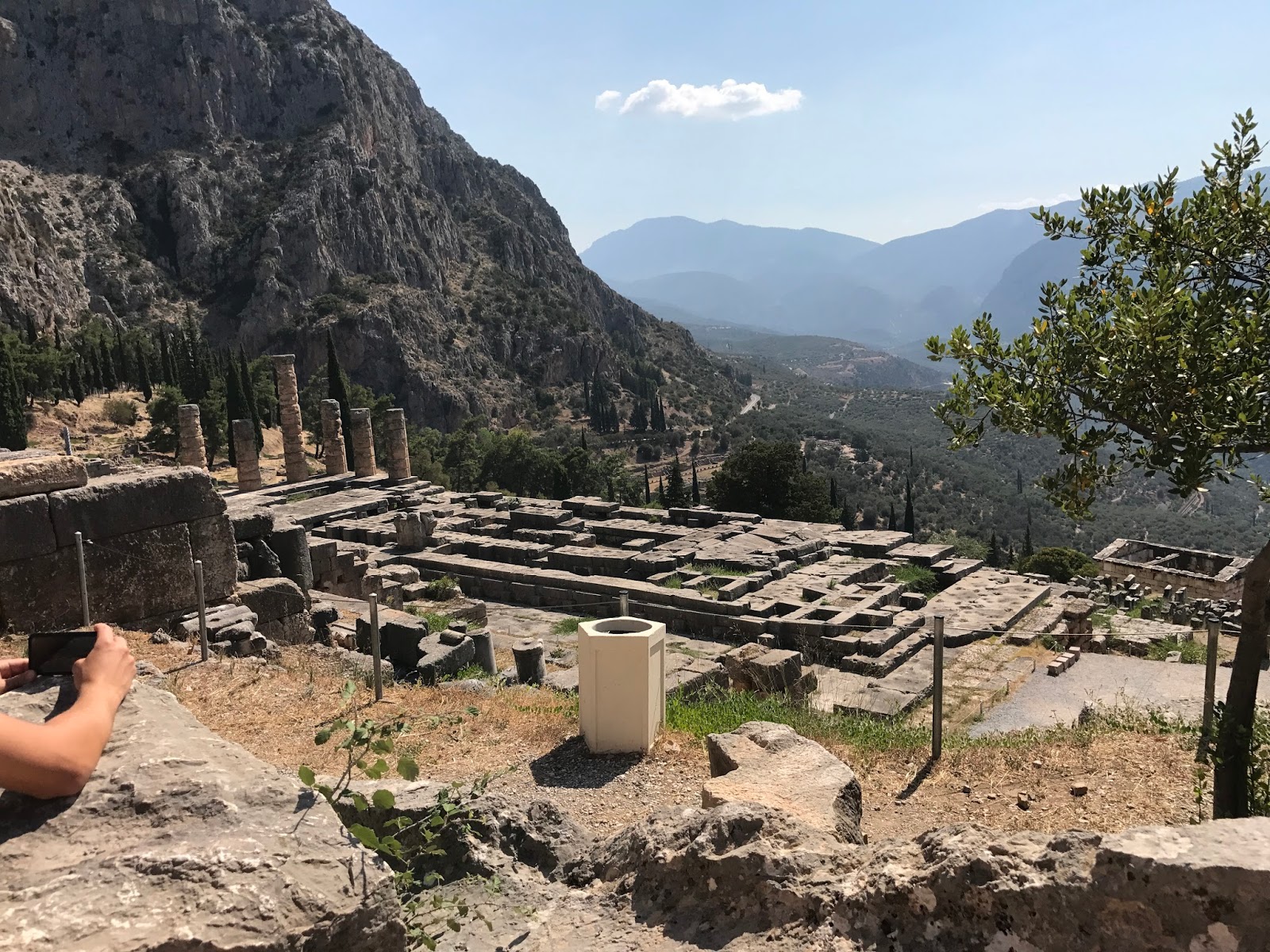
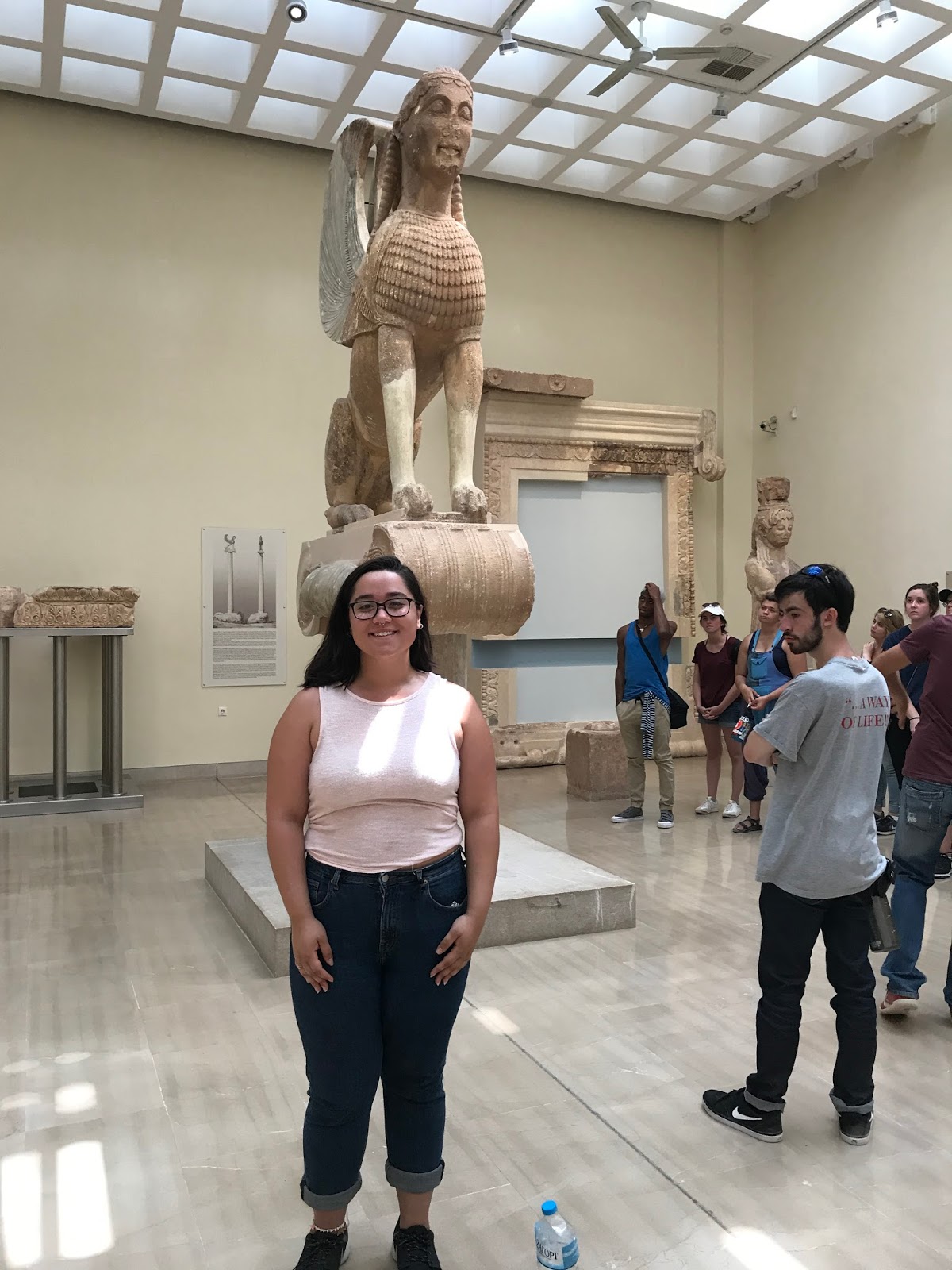
In the morning we woke up at 7:30 for breakfast and then headed to Delphi. Our exploration started at the bottom of the hill and ended at the top. Here our professors told us about the pithias and their oracles, the meanings behind the buildings and inscriptions on wall. Next, we saw the Museum of Delphi where beautiful artifact of the past are kept. There we saw the remains of the "Center of the world," as marked by Zeus; a sculpture of the Sphinx; remains of statues representing the war against the Amazons; and many more artifacts having to do with the athletics that took place here.


We left for lunch at 13:30. In Parnassos, I ate some delicious pastitio and walked around the town. From here we drove back to Athens.