Tuesday, March 11, 2014

Carnavali Patrino, Carnaval in Patra
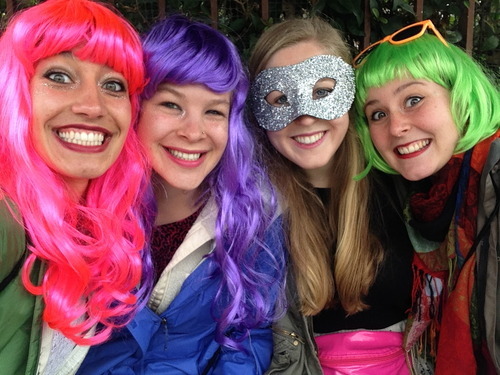
My friends and I had heard about Carnaval in Patras from our first few weeks in Greece, so we planned to go for the weekend of Clean Monday (March 3rd)! We knew very little about the weekend: we could compare it to Mardi Gras (which Hannah loves since she goes to Tulane), we had been told by many Greeks that this would be the craziest weekend of our lives, and we had been advised to get costumes. My friend Julia from Germany whom I met at Taft four years ago was coming to Greece to visit, so I told her to bring a costume. Luckily, she just HAPPENED to have a wig. Perfect. We all bought wigs at a party store in Pangrati to be properly prepared.
At the bus station on Friday, it seemed like the whole world was going to Patras! Patras is relatively big for the Peloponnese but small compared to Athens, so it was overloaded with people. Hannah, Catherine, Julia and I stayed in a hotel about 14 km outside of Patras so we had to prepare for the whole day and night when we left in the morning. On Saturday, we prepared for all the hype we’d heard about, putting on our wigs, masks and sparkles. The picture is the four of us at 11 in the morning. The bus and coffee that day were both a bit painful since we were the ONLY people dressed up! Soon enough we ditched the wigs and put them on later when other people were wearing costumes!

Over the weekend we went on a few of the carnival rides, hopped from street meat stands to street meat stands and various cafes to avoid the rain, watched the two 3 hour long parades and danced in the streets. We had the special black wine made and sold in Patras for the occasion, traded costume pieces with people and met a ton of Greek students - all in all a great first Carnaval!
Wednesday, February 26, 2014
KATHIMERINI
Last night I began my internship with the English edition of the Greek newspaper, Kathimerini! I wasn’t expecting to pick up something like this while abroad, but I found that I have a lot of free time so I thought it would be worthwhile to research extracurricular options. Nadia, the student affairs director, took my request to find some sort of economic volunteer job very seriously, pulling strings like one would for a child. After sending her my resume she set me up with Kathimerini because her friend is the editor! Basically, Kathimerini is one of the leading if not THE leading Greek newspaper, and there is an English edition that is published online as well as in the form of a paper insert that accompanies the International New York Times.
Last week I went in to meet them (at 8:00 because papers work late and I have class before then) to see how I could help. I’ll be going in on a handful of Tuesdays at 7:45 when I am done with class. Last night Nick, the deputy editor, gave me an “exercise” to start with. I read the European Commission’s winter forecast for 2013, 2014 and 2015 as well as a report specific to Greece, then synthesized the forecast for Greece in the context of the eurozone. I haven’t done much macroeconomic analysis, but I thought it was a manageable task! At the end of the night as I was walking with the others who were at the office until 11:15 to carpool back to Pangrati, one of the women told me to think about one or two stories I might like to write for them while I’m here! It seems like I may be published before I leave Greece!
Greek cooking class
On Monday after getting back from Istanbul I took the Greek cooking class offered in the program’s lunchroom with Meni, my new friend to say hi to! So far I’ve only known Despina in the lunchroom, but now I’ve spent some time with Meni too! The 7 students who signed up all went into the kitchen to make spanakopita, tzatziki, bifteki and french fries. We’re getting the recipes later this week!
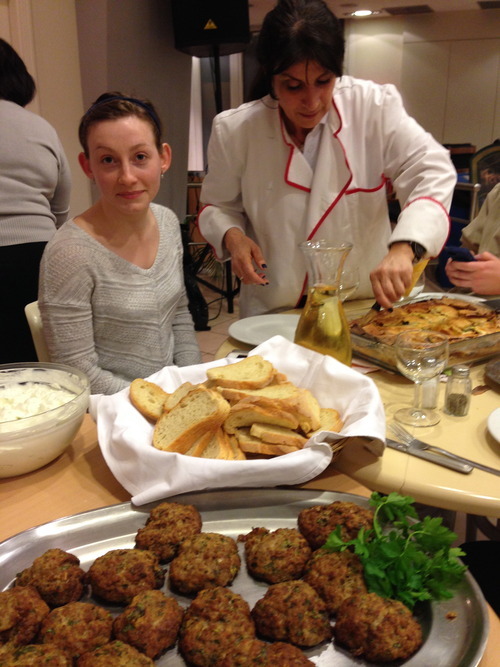
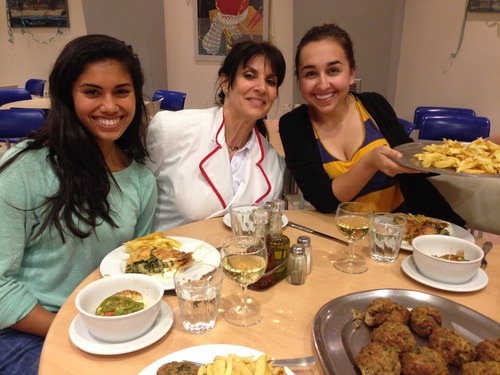
After cooking we all sat down to our home cooked feast!
ISTANBUL
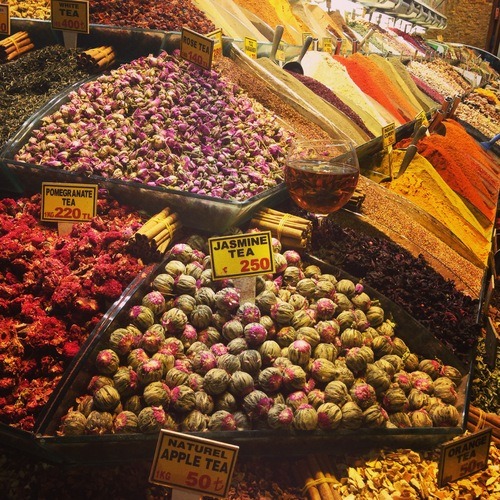
I spent the past weekend in Instanbul with a few friends from my program, so here’s a brief account of everything!
We had all of Friday, Saturday and Sunday, so it was ample time to explore, see the tourist hot spots and some other things we hadn’t heard about before.
On Friday, we walked from our hotel down the main shopping/walking street called Istaklal Street to get to the other side of the bridge where the Hagia Sophia and Blue Mosque are. From the bridge we could see about 5 mosques, and guessed that one was the Blue Mosque. It wasn’t the Blue Mosque (should have guessed by the lack of tourists), but we got to explore the Suleymaniye Mosque instead! We passed through the Egyptian spice market on our way to the actual Blue Mosque after, and saw the Blue Mosque as well as the Topkapi Palace. We went out to a Turkish dinner, then went to bed early since we were exhausted from a 7 am flight and walking all day!
On Saturday, we spent hours in the Grand Bazaar, being shouted out by the merchants to buy things, pick up the things we had supposedly dropped, and being called, “Spice girls!” I thought some shopkeepers in Athens were pushy… The six of us went to another Turkish restaurant for lunch, then I went off with my fiends Catherine and Lucy to go to a Turkish bathhouse. That was QUITE an experience! The hamam was built in 1481, and we could tell that this spa-like experience was much more deeply rooted in the Turkish culture than any spa is in the US. On our walk back from the hamam we ran into a riot on Istaklal street, which simultaneously intrigued and overwhelmed us. We watched from the entrance to a mall, tried to pass by it on the edge of the street, ran back to the mall when everyone else started running, tried again to leave the opposite direction, jumped when something exploded in the streets, were allowed to pass by a line of police who were blocking off a side street, and booked it back to the hotel! At the restaurant later that night, the waiter apologized for sniffling - he said he was reacting to the tear gas from the riot we saw! After dinner a few of us tried out a hookah bar to unwind and stay up a bit later.
Sunday was relaxing and a great end to the weekend. Catherine, Fiona and I were on a flight back to Athens in the evening, so we leisurely returned to the Hagia Sophia (directly between the Blue Mosque and Topkapi Palace) and spent a good hour inside. It was amazing, but I definitely wished I had some sort of tour guide! Otherwise we wandered, shopped, and had a relaxing day in the city before flying back to Athens. Such a great trip!
DELPHI
Delphi was my second favorite place to stay after Nauplion - it was very charming, also hospitable, and had amazing views of the mountains!
We got to tour the museum here with Anne Stewart again, and I have a picture of her in action above.
In all honesty, the site plan was too complicated for me to remember exactly what I saw, but I think the view gave the entire sanctuary part of its power. Being up above these ruins for an hour definitely required me to stop and take it all in. I saw the statues, friezes and sculptures in the museum that were on buildings and on the top of pillars, so I can only imagine what it would be like to walk through this site thousands of years ago!
The Sites at OLYMPIA
The modern village of Olympia is nothing extraordinary, but the people were very hospitable and kind! The museum at Olympia was my favorite of the whole week mostly because we were guided by the sculpture professor, Anne Stewart, who has a wonderful, engaging teaching style for on-site lectures. She told a story that really attested to the connection between modern Greeks and the ancient Greeks that I don’t want to forget:
Some years ago (I forget how many) she was watching the Greek news and saw the headline, “Ancient Olympia Museum in Flames.” As a specialist, she was very upset by this, but luckily the townspeople came to the rescue. Apparently, as the fire spread through the town and had reached most of the residents’ homes, it approached the museum. When the townspeople saw that the fire was almost at the museum, they abandoned their homes to go save the museum! The government gave the town a hefty amount of money for rebuilding their homes as repayment for their public service!
The first tableau I have above only includes the central figures of the frieze from the Temple of Zeus. It shows the scene of the chariot race between Pelops and Oinomaos. They stand on either side of Zeus to swear their honor and that they will not cheat (Pelops does not keep this promise). Pelops’ wife and daughter stand close by worrying about the coming race. It’s fitting that Pelops and Oinomaos were promising not to cheat in Olympia where the Olympic games began and drew many athletes who all took the same pledge! I saw the row of statues necessarily dedicated by the cheaters line the entrance to the ancient stadium!
Next are the statues of Hermes with Dionysos on his arm and the Nike of Paeonios. Notice the turtle under Nike’s foot!
Next is an illustration of Herakles’ labor to get the golden apples of the Hesperides by holding up the sky for Atlas while Atlas does the task for him. At the moment of the frieze, Herakles is holding up the sky and Atlas is holding the apples. Herakles looks at the apples as Atlas looks at Herakles, both acknowledging that Atlas could take the apples and be free of his horrible task!
Next is the workshop of Pheidius, the renowned Athenian sculptor who is supposedly the sculptor of the colossal gold and ivory statue of Zeus. Then is a toppled column from the Temple of Zeus, which housed this legendary statue of Zeus. Its drums fell just like dominoes and remained there ever since!
My friend Kristin is next to a fallen capital of one of the columns of the Temple of Zeus behind her. The capital matches exactly (in size and design) the capital at the top of the standing column in the background of the picture!
Next is the Temple of Hera, and then Kristina and Fiona in the workshop of Pheidius.
More from MYSTRAS
This Byzantine fortification and monastery is only a 10 minute drive from Sparta, so as we climbed (and climbed and climbed) to the top we could see Sparta beneath us. I’m not so sharp on my history, so I won’t go into it and risk getting it wrong. To say the least, this was one of my favorite sites of the week! We stepped inside two Byzantine churches to see it from an art history perspective. The faces and eyes of the figures on the walls and ceilings were mostly destroyed. I have a picture above of small plaques left in the churches that represent the ailments that worshippers prayed to the gods about. I thought those were very cool to see, since in the museum at Edipdaurus we saw stone carvings that served the exact same function at the Temple of Asclepius!
SPARTA
After spending two nights in Nauplion my bus (there were two buses) spent Wednesday night in Sparta! Amazingly, the movie 300 was on TV that exact night, so I have now watched 300 while I was in Sparta.
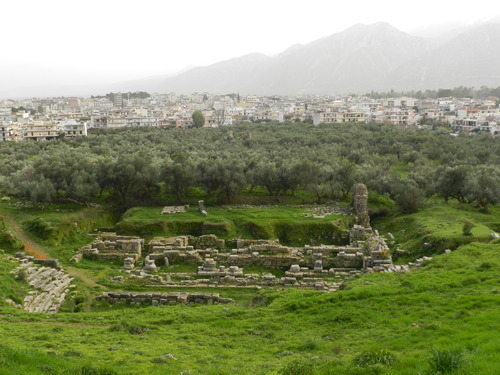
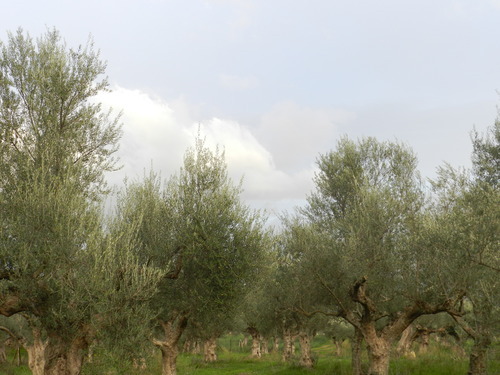
When we arrived, we hiked up to the acropolis of ancient Sparta, which really wasn’t so much to see. However, from the acropolis we could see a beautiful olive grove at the base of the hill.
After seeing this there wasn’t much to do, so I went down to the track at the end of our hotel’s street (past the massive statue of King Leonidas) to run. Within my first few laps I fell into step with an older man who spoke no English whatsoever, but as we weren’t running at different paces, I tried to give my Greek a go. It was especially funny to find a comfortable pace for both of us using the words for “slowly, slowly,” “come on,” “I’m ok,” and some sign language. Here is what I *thought* I understood after our 30 minute jogging conversation:
His name is Niko. He works as a chef in a taverna named Varlas in Sparta, but there is also a second location of Varlas in Athens. He has been to Canada. He runs marathons, ran THE marathon possibly last fall, and is preparing to run a marathon to Tripoli from Sparta. The reason he can run so fast is because he drinks red wine. He is 50 something years old. He does not speak any English.
With my baby Greek, I think that we talked about my program, the itinerary for my weeklong trip, where I was from, Greek food, marathons, track and field events (apparently they don’t have pole vaulting in Sparta…).
After rallying a group of friends to find Varlas, I learned that I should not be so confident in my Greek. I asked the servers at the taverna if they knew Niko, and, first of all, they barely understood my question. By the end of the meal we had found someone in the restaurant who spoke both English and Greek, and through a few conversations it turns out that Niko had merely RECOMMENDED this taverna, and that he did not work as the chef. Silly me. Either way, I made it through a 30 minute conversation in which I didn’t speak any English!
LERNA and TIRYNS
On Wednesday we visited Lerna, home of the Lernaean Hydra, another of Herakles’ labors, and Tiryns, both in the Argolid. We saw the House of the Tiles, named so because there were tiles on the roof. That’s the first picture. The site was relatively small and not as impressive as Mycenae or Tiryns, but I still enjoyed it, especially when our professor pointed out the herringbone masonry! Shout out to good old Herringbone and her happy sailors!
At Tiryns we saw more cyclopean structures (walls built with impressively large stones), shaft graves and access to water within city walls. It is similar to Mycenae, perhaps made with even bigger stone blocks. My group discussed it in relation to Mycenae for the paper we have coming up, so we hypothesized about the kind of relationship these two citadels had.
My second to last picture is a tunnel within the wall at Tiryns, which my dad will enjoy: It was roped off so I couldn’t go down the passage, but at the end on the left of the picture there should be a slight shine on the stone. When shepherds would lead their sheep through this tunnel, the sheep’s wool buffed and polished these stones so that now they shine! Just a fun fact!
EPIDAUROS
The theater at Epidauros is one of the most impressive structures we saw, because its acoustics completely carry sound from the orchestra to even the highest seats. It was amazing to sit on the stone seats (so comfortable!) while different groups of students climbed up and down, yelled to each other, and the whole time sitting in the audience I had a beautiful view of the mountains in the background. Not too shabby!
We then toured the site of Epidauros that includes a Temple of Asclepius, the Asklepieion of Epidauros (where the ill could come sleep, connect with the gods and be healed), a Temple of Artemis, the Abaton Dormitory, a hestiatorion (place for ritual dining large enough to fit masses of people), and a Roman Odeion (enclosed performance hall with a rounded audience). The site was a large field of ruins, large blocks and a few surviving columns here and there. One of my pictures shows a rounded structure, which was a sort of tholos (meaning round…like the tholos tombs at Mycenae) temple with Corinthian column capitals and an intricate foundation that suggests the possibility that there once was a labyrinth of snakes below the temple. The professors who accompanied us and guided us around the site assured us there was no evidence to support this myth, but it would have been cool!
The last picture is a Mycenaean bridge that we saw just as a quick pitstop along the present-day highway. Those stone blocks are not small!
Subscribe to:
Posts (Atom)