Thursday, February 16, 2017

The City of Mosaics


The second part of our weekend trip was in Ravenna, Italy. On Saturday, after our time in Venice, we took a bus from Mestre to Ravenna, driving along the Adriatic Sea and through traditional Italian villages. After we arrived in Ravenna, my roommates and I walked into the center square of the town in order to find somewhere to eat dinner. During dinner, we belatedly celebrated my roommate's birthday with traditonal Ravenna cappelletti and  Ravenna custard for dessert.

The Streets of Ravenna

                                                                                                                                                                              After breakfast at the hotel on Sunday morning, we traveled to Classe, where the Basilica of San Apolinaris is located. Not only were we able to see the famous mosaics of this sixth century church, we also had the amazing opportunity to sit for part of the 10:30am Sunday Mass. I am  Catholic, so it was a very humbling experience to be sitting in a sixth century Basilica surrounded by the mosaics of all the previous Bishops of Ravenna, while the Mass was performed. The mass was in Italian, which made it harder to follow, but I knew the structure of a Catholic Mass enough to be able to follow along and recite in English. For me, part of the beauty of attending this Mass was the lack of barriers during the service. The language did not serve as a barrier, as faith served as a common bond and the sanctity of the space was present even to those who weren't practicing Catholics. We had to leave during the homily, in which the priest was interacting with his Parrish (which I have never seen before), and it was weird leaving the church in the middle of the Mass. I have never left during the middle of a service before and I would have enjoyed receiving communion in the sixth century Basilica of San Apolinaris as thousands have done over the centuries.


Christ and His Flock at the Basilica of San Apolinaris in Classe

After leaving the Basilica we returned to Ravenna, where we toured both the Mausoleum of Gala Placidia and the Basilica of San Vitale. I have studied Gala Placidia in passing during courses on Byzantine history, but because her influence extended over the Western portion of the empire, not much time was spent on her life. Let me tell you, she was awesome. Not only did she politically maneuver her second husband onto the throne of the Western part of the Empire and serve as regent for her son upon the death of her husband, she also maintained the Western part of the empire, strengthening its economic and political structures. She was so influential in fact, that within her mausoleum (which is shaped like a cross) her tomb is in the position of central importance and she is flanked by two emperors. The mosaics of the Mausoleum are absolutely incredible and definitely denote her power within Byzantine society. The gold tesserae used in the mosaics for the mausoleum are made with up to sixteen layers of gold foil, whereas the tesserae used in the Basilica of San Marco only have two layers. My professor, who guided the tour, spoke a lot about the process being undertaken by the students at the University of Bologna at Ravenna to refurbish and preserve the mosaics in their original form. This process of reconstructive archeology again peaked my interest. I never really considered graduate school after my bachelors degree, but after seeing the work in Epidauros and Ravenna, I have starting researching reconstructive archeology programs. 

Entrance Vault to the Mausoleum of Gala Placidia

Central Dome and surrounding Apse of the Mausoleum of Gala Placidia

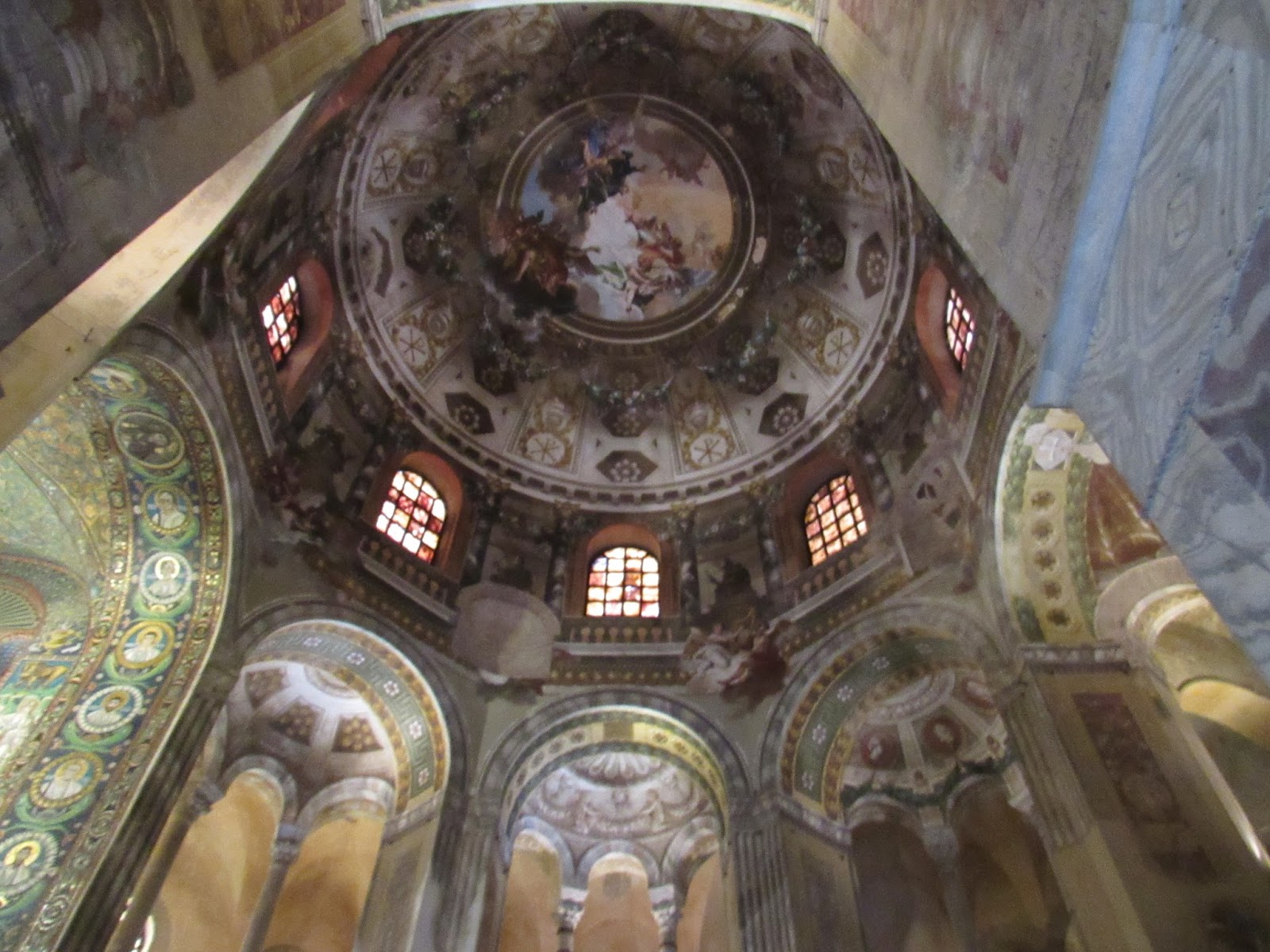
From the Mausoleum of Gala Placidia, we proceeded to the Basilica of San Vitale. Though it is called a basilica, it is not actually a basilica, instead, San Vitale is octagonal in shape with one central dome. The central dome and the upper levels are decorated with sixteenth century frescoes, but the mosaics applied to the main apse are originals from the sixth century. Mosaics served as literacy for the illiterate, who could "read" the narratives portrayed in the mosaics.

Outside view of the "Basilica" of San Vitale

Sixteenth Century Dome Decorations

Due to the fact that I had previously been to Venice, the reason I went on this trip was to see the mosaics of the Imperial Couple, Justinian I and Theodora. Theodora is my favorite Byzantine Empress (which might be cliche because she is the most famous Byzantine Empress) and when asked my senior year of high school who I would wish to have dinner with from history, my answer was Theodora. For me, Theodora embodies the essence of Byzantine society. She has a rags to riches story in which she begins life as a prostitute and is buried in purple and gold. She was ambitious and beautiful, but most of all she was smart. Within Byzantine society there were windows of opportunity for social elevation - a prostitute could become an empress and a stable boy could found a dynasty - if one seized the opportunities presented to them. That is exactly what Theodora did. She found a love match in her marriage to Justinian I, which brought her into the imperial court, she also maintained property in her own name, and she used her political acumen to defend her place on the throne, preserving her husband's reign. I was so excited to see the mosaic of Theodora in all of its magnificence, and I was not let down. Justinian's mosaic is technically impressive, but Theodora exudes power. Theodora's presence commands the room as if her spirit lives on in this icon. It is even rumored that the halo surrounding Theodora is larger than that of Justinian. 

Justinian I and Retinue

Theodora and Retinue
Even without the portraits of Justinian I and Theodora, the mosaics of San Vitale are impressive. The colors are so vibrant and lifelike, telling the story of the Old Testament and the history of the Christian religion. The gold is stunning and the people depicted remain immortal through these tiny pieces of stone that together form masterpieces.

Mosaics of Abraham and the Twelve Apostles

After San Vitale, we were given two hours to explore Ravenna, which proceeded to revolve around food. After lunch at a hot sandwich restaurant where the employees were so excited to practice their English, we sought out a gelato shop, so that we could eat gelato in Italy. My roommate Amy also wanted to get some fresh, homemade, Italian pasta to bring home to Greece. The pasta shop was run by a women who spoke no English and we spoke no Italian. By using a mixture of Spanish (Amy) and Latin (me) we were able to communicate with the woman and buy a half-kilo of cappelletti! Whoever said Latin is a dead language is wrong...its immortal.
Caramel and Cinnamon Gelato

Not only were the mosaics of Ravenna incredible but so was the street art. One street had a series of famous historical figures associated with Ravenna depicted riding bikes, which provided a quirky timeline of the history of Ravenna.

Theodora
Gala Placidia


Saint Vitale and Oscar Wilde

The mosaics of Ravenna were everything I had imagined them to be and more. I am so glad I was able to see these mosaics, especially because I will be studying a lot of them in my Byzantine Art and Architecture class this semester. I have to admit, after three days of Italian, it was really nice and comforting to see the Greek alphabet again in the Athens airport upon arrival.

Wednesday, February 15, 2017

The City of Masks


Every semester, CYA/DIKEMES offers its students three optional trips that are planned by the university and are guided by the faculty. Part of my travel stipend from the George A. David scholarship went to participating in two of these trips. The first, a three day trip to Venice and Ravenna took place this past weekend.

The trip began with a 5:45am meeting time in front of the Kallimarmaro Stadium from which we boarded a bus to the airport of Athens. I am always surprised by the different security measures upheld by different countries. For my flight to Italy I did not have to remove my shoes for scanning or show my passport prior to the departure gate. Greece also has a policy with the Schengen coutnries which allows travelers to travel between these countries without custom declarations. 

When we landed in Milan it was snowing! Athenian winters are really mild and it was really nice to see the snow, as if  a small piece of home joined me on my trip to Italy. From Milan we took a three and a half hour bus ride to Tronchetto, a port of Venice, where we boarded a vaporetto (ferry) which took us to the main island of Venice. We spent the night taking a guided walking tour of Venice, from San Marco to the Rialto Bridge and back. I was really exciting, and more than a little proud, that I was able to recognize streets and landmarks from my previous trip to Venice, as I take great pride in my navigation abilities. After the guided tour, we were given time to walk around the Piazza of San Marco, where we were able to see the carnival floats being constructed.

Piazza San Marco  and Carnival Floats

After the walking tour, we traveled to Mestre, the center of mainland Venice, where our hotel was located. For dinner my roommates and I went to a local dinner where I got an Italian gyro... the Greeks definitely do it better. 

On Saturday, we had breakfast at the hotel before traveling back to Venice for the day. We started our morning at the Basilica of San Marco. We were able to see the evolution of the city of Venice, from its beginnings to its rise as a commercial power, to its Byzantine, Ottoman, and eventually Italian influences, through the different art adorning the church. We saw the external and internal narrative mosaics, as well as the alleged body of Saint Mark. While we were in the Basilica, a morning mass was being performed, and although the mass was being held in one of the peripheral sections of the church, I am glad that we got to see the Saint Mark used for its primary function, as it was a reminder that the church, despite its art, also serves as a holy place of worship, putting the art and architecture in context. While I had seen the Basilica during my previous trip to Venice, I was able to see the Pala d'Oro and the Treasury for the first time.  

Pala d'Oro (from google images) - This does not even do it justice.

The Pala d'Oro is a giant icon (3 meters x 2 meters) that is located behind the main altar and the tomb of Saint Mark. Not only is this piece breathtaking it is also overwhelming to see in all of its splendor. The Pala d'Oro is made of gold, enamel, and over 3,000 gems and precious stones.  The piece contains depictions of the Life of Christ, the Life of Saint Mark, the four Evangelists, the apostles, prophets, and the Virgin Mary. This icon is an extraordinary example of Byzantine craftsmanship as well as the tremendous wealth of the Venetians in the middle of the fourteenth century. My favorite part was the icon of the Byzantine Empress Irene, who is depicted in the center of the bottom row, to the right of the Virgin. Though Irene was an empress during the late eighth century, she takes the position of importance to the right of the Virgin, while the reigning Doge is placed on the left. This placement emphasizes the role of women within the Byzantine sphere of influence, as both are placed in positions of importance, recognizing their individual roles in Christianity - the Virgin through her birth of Christ and Irene, who fought against iconoclasm during her time as the sole ruler of Byzantium. In fact, it could be interpreted that the artist considered Irene one of the "patrons" of this icon set due to her dedication to upholding icons. 

Empress Irene (also from google images as we weren't allowed to take pictures)

After the Pala d'Oro we were able to see the Treasury of the Basilica, which serves as a museum for some mosaics, column capitals, and statues. My favorite part of the treasury was seeing the Prophyry Tetrarch statues, that depicts the four tetrarchs embracing. This statue was looted from Constantinople in 1204 and brought back to Venice. The tetrarchs were the precursors to the Byzantine Empire, and therefore hold a special place in my heart. We also got to see the Four Horses of Lysippos. While these bronze horses have been inaccurately attributed to the Greek sculpture Lysippos, the craftsmanship needed to express the bulging veins of exertion and the mouths bleeding from the bridles is impressive. I did not know that the horses and tetrarchs of display in San Marco were replicas until I saw the originals in the Treasury, so I really enjoyed seeing the originals - which are of much better quality once a comparison can be made.
 
Tetrarchs and the Horses of Lysippos

After finishing our tour of the Basilica, we toured the Doge's Palace, which contained the residential suites of the Doge's, the legislative and judicial  center of Venice, as well as the attached prison. We got to walk up the golden staircase, through the armory and then across the Bridge of Sighs (named so due to the fact that it was a prisoner's last look at the sun) into the actual prison.


Bridge of Sighs

We were then given two hours of free time in which we could eat lunch and explore some of Venice on our own. My roommates and I joined a few other CYA students and went to the Correr Museum, where we saw Venetian artifacts, including maps, globes, coins, statues, and even the ball room of Napoleon and the residences of Empress Sisi of Austria. After a quick lunch, we sought out one of the top ten bookstores in the world - Libreria Acqua Alta. Here, they keep books in bathtubs and gondolas in order to prevent water damage as a result of frequent flooding and have a stairs of books overlooking the canal. This was my second time at the bookstore and it was exciting to go again, as if  establishing a Venetian tradition of visiting this bookstore.

Acqua Alta

Acqua Alta

We were in Venice for the opening weekend of Carnival. The streets of Venice came alive with decorations, while locals and tourists alike donned masks and costumes to celebrate the beginning of the Carnival season. Venice has always held a sort of magic for me. When walking in Venice, it feels as if the streets and bridges come alive, as if one never quite knows where they are or where they are going. Seeing Venice during Carnival was one of the items on my bucket list, and I am so blessed that I had the opportunity to not only return to Venice, but also see the islands transform with the magic of Carnival. It is not hard to picture the grand parties, dancing, and revelry of times past when the masks fill the city.


My roommate Amy (right) and me (left) in our carnival masks.

Thursday, February 9, 2017

No Nations, No Borders

To America, the refugee crisis is a far off “threat.” To Greece, the refugee crisis is currently shaping the foundation of Greek urbanism and culture. Greek shores are populated with refugee camps that provide poor shelter for homeless migrants. And while Greece is straining under the stress of their own economic issues, as the rest of the Western world closes their borders, the Greek people are welcoming all of these people – from Syria, Iran, Afghanistan, Iraq, Pakistan, and Eritrea – as best as they can.

Since arriving in Greece I have had the honor of volunteering with City Plaza, a converted hotel that had been abandoned during the worst of the economic crisis. City Plaza is a refugee accommodation center that relies on volunteers to run and is organized without any social hierarchy. Here refugee families have shelter, privacy, and food, while also participating in community events, Greek and English language classes, and skill development classes. Children receive mathematics and language tutoring as well as a safe place to play and grow.

Last Sunday, the Acropolis had free admission for the day, and City Plaza had organized an excursion for the residents to visit the Acropolis. Tenzin, my roommate Amy, and I joined the City Plaza volunteers to help watch the children attending the trip. Many of these children know Arabic, Farsi, Greek, and English, but I was nervous about keeping the children safe with such a language barrier. After dividing into groups (which promptly disintegrated as the children moved around) we took the metro from Victoria Station to Thissio on the greenline in order to get within walking distance to the Acropolis. We then proceeded to walk as a group through the street markets of Plaka to the Acropolis.

It was during this journey that I was able to meet with the children for the first time. Three little girls with impeccable English, asked me for my name, and proceeded to laugh at how American I look with my “white, white” skin and blonde hair. When I told them that they also looked American they told me that they were not white. The innocent observations of these children were gut wrenching. I have always been proud of the diversity in America, yet due to the political climate and the media’s portrayal of the United States, these refugee children do not even believe that they could have a place in the U.S. On the walk up to the Acropolis, I was adopted by a family from Afghanistan. I held hands with the youngest daughter, dressed head to toe in red, as we walked up the hill, while the mother and I spoke in bits of English and Greek, and a lot of hand gestures. Language often is seen as a divider, yet despite the fact that we didn’t share a common language, we were able to learn about each other and appreciate the others company. Humanity is the common language. When the little girl saw a cat and a dog, they taught me the words in Farsi, “pishi” for cat and “sag” for dog.

Once we had entered the Acropolis, Sova, a six year old girl, climbed on top of my back and I carried her up the side of the embankment to the top of the Acropolis. We established a marching beat “ένα… δύο … ένα… δύο…” Eventually I began to count pass δύο in order to practice our knowledge of the Greek cardinal numbers. I only knew up to έξι – six and couldn't remember seven, and so I was going to start back over from the beginning, but Sova continued with the Greek numbers counting all the way up to 50! She proceeded to teach me the numbers until I could say our marching beat by myself. Days later when my Modern Greek class was learning the numbers, I was able to say them, courtesy of Sova.

For so many of the residents of City Plaza, this was their first time to the Acropolis and it was really amazing to see it through their eyes. It provided me the opportunity to be taught Greek by six to twelve year olds, and to watch children who have been through so much enjoy themselves. It also provided us with the opportunity to come together despite different languages, religions, and countries of origin. I was to talk to and hug a former Afghani soldier who saw firsthand the civilian deaths caused by the American military involvement in Afghanistan. I had apologized to him for the current administration’s policies and for the pain, ostracism, and racism that he and his family have to face due to the propaganda of America, Hollywood and the Media, and the Western world. I am so blessed that I was able to meet him and hear about his struggles and losses and know that it is kindness and love that brought us together.

The refugee crisis in Greece is not ideal. The Greek government and people do not have the resources to aid all of these people fleeing horrors, and as a result many refugees are forgotten. Their futures are taken away from them, and their pasts are erased. In an era of globalization, it is our duty as a citizen of this world to join together to aid our fellow humans however we can. Donating, volunteering, advocating all help to raise awareness and build bridges among neighbors. Greece has an advantage in aiding refugees, the Greek people acknowledge that a lot of their culture originates from the contact with the East – currency and an alphabet from modern day Syria and Lebanon, music from Turkey, agricultural techniques from Iraq and Iran, religion and myths from Turkey to Afghanistan. The Greek people are a direct product of these refugees’ culture, and as a result, so is much of the West. City Plaza is truly a place of no nations and no border and I am looking forward to learning all that I can from the residents.


No Nations, No Borders


Monday, February 6, 2017

Getting Lost... Getting Found


Getting Lost... Getting Found


This past week was the first week of classes, and also the first week of my study abroad experience for me to explore on my own, without the aid of the CYA/DIKEMES administration. Last Sunday, I was walking through Plaka and stumbled my way into the Athenian Flee Market in Monastriaki. Totally by accident, I found myself in a true gem of Athens. Everywhere people were selling everything from old keys and books, to chairs, rugs, and icons. The flee markets stretched through streets, alleys, and squares. I spent the entire market walking from one stall to another trying to understand some of the Greek, watching the Athenian people haggle with prices, and seeing the ancient streets of Athens come alive with their makeshift agora.  While walking through the flee market, I proceeded to get lost among the twisting streets of Monastiraki. Instead of attempting to retrace my steps, I comforted myself with the theory that you do not truly know a city until you get lost and then find yourself again. I continued to wander the streets and the flee market until I came out in Syntagma Square, the Parliament building standing as the backdrop. I had missed the Sunday morning changing of the guards, so that was placed on the list for another Athenian Sunday. 

This week was also the first week of classes, allowing me to begin studying the subjects that I love in a setting that encourages the interaction with the physical evidence of my studies. I am taking four classes this semester. Two classes on Monday/Wednesday - Modern Greek and History of Ancient Macedonia - as well as two classes on Tuesday/Thursday - Sports, Games, and Spectacles in the Ancient World and Byzantine Art and Architecture. I am so excited for all of my classes, some of them - like Modern Greek - I would never have been able to take at Tufts University, and some of them - such as Sports, Games, and Spectacles - are offered at Tufts, but with CYA, we are not only being taught by professors at the top of their respective fields, but also get to go on field trips that enhance the class - Olympia, Pella, Thessaloniki, and Ravenna!

On Wednesday after my classes for the day were finished, I went to the Post Office in Syntagma, in order to buy international stamps to send a postcard. I wasn't sure how Greek post offices work, especially at a larger branch, so I approached a man waiting and asked him how to go about getting a letter sent. After helping me get a number, we proceeded to have a multilingual conversation, with Nikos asking me questions in English, and me answering in (botched) Greek. We had just practiced this type of conversation about where we were from and where/what we were studying in Greek class that day. It was so rewarding to be able to practice my Greek and converse with Nikos in his own language without too much of a language barrier. Nikos even gave me his telephone number before he left the Post Office and told me to call if I ever had an emergency while in Greece.

Saturday, I took a day trip to Epidauros in order to see the Sanctuary and Theater of Asklepios. Last semester, at Tufts, I took a Ancient Greek and Roman Medicine class, where we spent a lot of time learning about the cult site of Asklepios at Epidaurus and the role of divine healing on the development of the medical techne of the time. I got up around six a.m. to take the metro (first time by myself!!) to a suburb of Athens in order to get on a KTEL bus to Kranidi, which had a stop near the sanctuary. After a little panicking about missed stops, and help from a very nice bus driver and some translating Greek passengers, I got off the bus a kilometer from the Sanctuary. I found it very adventurous of me to be walking off a bus and proceeding to walk a kilometer on a deserted road, surrounded by olive farms, in order to reach the sanctuary. On a side note: I really love the way that the olive trees  make the mountains look silver, as if they are gilded.

Road Sign to the Ancient Theater of Epidaurus

 Once at the Sanctuary, I started at the Theater of Asklepios, where theater performances took place in order to entertain the invalids seeking divine healing from Asklepios. I have seen the theater complex at Pompeii but the shear size of the Theater of Epidaurus was breath-taking (literally, I actually gasped when I came through the trees and first saw the structure). The acoustics were also amazing and I am in awe of the technical level of engineering required to not only carve out the hill formation and construct this theater, but also calculate the precise angle and size required in order to create the acoustics. I could clearly hear the tourists speaking from the ground all the way at the top of the structure as if they were sitting next to me. In the following picture a small stone is visible in the center of the sand in the circular platform on the ground level of the theater. When you stand on that circle, your projection is the strongest, but even cooler is that if you tap your foot on that stone circle, the tapping sound reverberates back at you amplified.

Top Down View of the Temple of Epidaurus

Ground Level View of the Theater of Epidaurus

After spending time at the theater, I spent two hours at the archeological site of the Sanctuary of Asklepios. Here I was followed, and at times guided, by a stray dog. Dogs were sacred to the god Asklepios, to whom the theater and sanctuary were dedicated, and were often kept at the sanctuary for healing purposes, as the Greeks believed that ailments could be cured by the lick of a dog's tongue. Being guided through the site by the dog, felt as if Asklepios himself was guiding my tour through the hostel, baths, and temple ruins.

Dog of Asklepios

The remains of the Propylon among the ruins of the Sanctuary of Asklepios

Visitors of the site approach the ruins of the Sanctuary in the reverse direction from the traditional procession of supplicants during antiquity. Having learned about the proper steps needed to be admitted into the Sanctuary complex for healing, I wanted to walk through the Propylaia, past the Cistern, and up through the sacred way. The picture below shows the remains of the Propylaia, which would have mirrored the appearance of a temple while the site was getting used. After crossing the Propylaia, I stopped at the cistern and used my water bottle to wash my hands, in the same manner supplicants two thousand years ago would have washed in order to achieve physical purification before entering the Sanctuary.


Propylaia of the Sanctuary


Cistern

I then proceeded to the Abaton, which is where the invalids would have slept in order to receive, in their dreams, healing from the god, either in the form of Asklepios himself, a dog, or the elaphae longissima longissima, the sacred snake of Asklepios (which I sadly did not see). Having read the stelae containing written accounts of the miracles believed to have been performed here in the abaton, it was surreal to be in this place of healing. In fact, I laid down on the marble benches against the back wall in order to partake in the process led by thousands of others before me.

Abaton of Epidaurus

Due to the fact that the Tholos Temple, a round temple in which the sacred snakes of Asklepios are believed to have been kept, is being refurbished and reconstructed, I was able to see the methods that archeologists are using in order to reconstruct these monuments as precisely as possible while maintaining the integrity of the ruins. As seen below, the archeologists are using an exacting tool, a modified version of the tool used by the Romans in order to make exact replicas of Greek Bronze sculptures in marble, in order to etch into marble. The archeological remains are then placed within these marble pieces, and the Tholos Temple will then be reconstructed so that the public will be able to view what the original temple would have looked at while still seeing the remains in their correct orientation within the ruin. Seeing this method of archeology has made me think about reconstructive archeology as a career path, which I had never considered before.

Reconstructive Archeology
Along with the Theater and the Archeological Site of the Sanctuary, the site also houses a museum which contains the sculptures and material finds of the archeological site. For me, the most exciting material objects on display were the copper-alloy medical instruments: scalpels, forceps, tweezers, cautery irons, and probes. The evidence of these instruments at the Sanctuary of Asklepios prove that the site served as more than a location for divine miracles but also as a site where actual medicine was practiced.

Tweezers, Scalpels, and Cautery Irons from Epidaurus

Medical Probes
Epidaurus was an incredible day trip out of Athens. The trip gave me confidence to travel alone, take public transportation, and to trust the people of Greece to help get me where I am looking to go. I am so thankful that I was able to see this ancient marvel. Part of the beauty of Athens rests in the fact that the city is a testament to the Athenian people throughout history, with Classical, Byzantine, Early Modern, and Contemporary architecture right next to each other. Epidaurus, however, was a strong break from the charm of Athens. Situated in a forest of  whispering trees in a valley between silver mountains, the site almost serves as a small asylum for Ancient Greece, untouched by the modern era except for the inevitable passage of time and monumental collapse. And if one squints (really hard) it is almost possible  to see the line of supplicants making merry while waiting to be healed by the god.

Statue of Asklepios

Friday, January 27, 2017

Γεια σας!


Γεια σας! 


Με λένε Sarah. I am a junior Classical Studies Major at Tufts University, and I am the honored recipient of the George A. David Fellows Award for the Spring 2017 semester at College Year in Athens. 

As a Classical Studies Major I have read and studied about Athens and the local monuments for so long that it is both awe-inspiring and breathtaking to be living in a city with over three thousand years of history present around every corner. For the first two days, I had been frantically avoiding looking at the horizon of Athens, because I did not want to have my first sight of the Parthenon to be from a third story window, but instead from below, like the Ancient Athenian supplicants of Athena. On Wednesday morning, the weather began to clear and I left our apartment early before our orientation began and walked to the Parthenon for its opening. I left my map behind and took my chances, walking through the National Gardens, passed the Arch of Hadrian, and the Temple of Olympian Zeus. 


The Parthenon took my breath away. As I stood in the shadows of this ancient wonder I couldn't help the tears that welled in my eyes and that streaked down my face. Even with the scaffolding and cranes, the acropolis thrummed with the history of all those who had approached the temple before me. Despite the fact that according to physics, the universe is approaching entropy and chaos, the columns of the Parthenon are actually over time fusing together and becoming more perfect -- which I find to be quintessentially Classical Athenian in principle. And tomorrow, when I hike to the top of the Acropolis again, I will again experience it at its most perfect form of the two thousand five hundred years of its existence. 


 After approaching the Parthenon from the perspective of a supplicant, I wanted to see the temple as Athena would have -- from above. The Parthenon is such a prominent mark on the landscape, it is incredible it imagine the economic and popular resources needed to construct the temple. This picture was taken from the top of the Stadium in Pangrati.


Today we practiced our Greek at the weekly Farmer's Market at our street, where we bought fruits and vegetables for the upcoming week. I have not yet met an Athenian who isn't excited and willing to help me practice the Greek language.


Although I have only been in Greece for a week, the Athenian people are some of the nicest people I have ever meet in my life. At the farmer's market, the nut vendor, gave us free peanuts after I bought a half kilo of almonds, and a fruit vendor gave us two lemons for free, after refusing payment. This kindness is something that I have never experienced in America.The compassion and welcoming nature of the Athenian people is everywhere... from shops, to dinner, to their graffiti. 


I feel so welcomed by both the entire CYA staff and the Athenian people, and I can not wait to see where this semester takes me!

Sunday, March 20, 2016

The Cats of Delphi...and more! :)

This past weekend CYA took us on a short, yet absolutely marvelous field trip to the small city/town of Delphi, Greece. Having not known much before the trip, I was really excited to be visiting a place where people would ask questions to an Oracle who could foresee the future. 

The school divided the students up into two buses to make things more manageable once we arrived at the sites. The ride to Delphi took about 2 hours, but first we made a stop to the Ossios Loukas Monastery. Professor Kotoula, my Byzantine Art and Architecture teacher, guided us through the old monastery and explained to us all the cultural significance behind the church. What I found the most interesting of the Ossios Loukas Monastery was the bottom chamber, where we saw figures on the wall with their eyes carved out. I had learned in class that messing up the structure of the face alone was the greatest way to reject or show disrespect towards an icon in a church. Seeing that really reflected the tensions that occurred between the groups who tried to have power in the church. After our visit, we had a quick picnic lunch provided by the school at the monastery. Unfortunately it was super misty so our view wasn’t spectacular, but I was super hungry and will eat food whenever and wherever.


When we arrived to Delphi, the weather didn’t get any better. It was super rainy and we were told that the archaeological sites of Delphi would be extremely muddy. We decided to just relax in the hotel for the rest of the day and grab dinner. We also saw beautiful Greek cats during this trip! They are soooo adorable and my love for cats has increased since this trip. After dinner, the girls I was sharing a hotel with and I just decided to watch Greek soap operas and were impressed by how much we could understand after only being in Greece for two 2 months! 


The next day we rose up bright and early at 7 am. Luckily, the hotel provided us with breakfast and I reenergized myself with croissants, eggs and fruit. We visited the lower archaeological site at Delphi first. There we saw a temple dedicated to Athena and there was also a surrounding gymnasium. Every time I visit one of these temples, I am always blown away by how much man-power was put into the works I am witnessing and the durability of these structures. Next, we climbed our way up to the upper archaeological site in Delphi and saw the temple of Apollo, as well as a  grand stadium. We also saw where people made their sacrifices to the Oracle! Of course I knew there were a queue of wishes waiting to be granted, but I asked the Oracle my question anyways. I hope he heard it! J

We finished the field trip off by going to a nearby town called Arachova. It was super beautiful and it was the first time I had ever witnessed a snow-covered mountain top! Greece continues to make me fall in love with it every time I visit. I don’t know how I’m going to go back home!

Enjoy the pictures J


 Temple of Athena
Temple of Apollo/Oracle site at Delphi
Cute Greek cats everywhere! 

Arachova, Greece!

Wednesday, February 17, 2016

Athens: Land of Gyros, Cute Cats, Fantastic History and More Gyros

Ah....Αθήνα, where do I begin? 

Looking back at my past three weeks since I got to Athens at the end of January, I can truly say that I am very happy with the choice I made to study abroad in this unique city. I think it's extremely important to emphasize that each of my experiences would not be possible without the help of Professor Proctor and the George A. David and Marina Spiropolous Fellowship award :) So for the 100000th time, thank you!

Feeling like I'm on top of the world at Lycabettus Hill

For those of you who may not know me, I am a community health major, and also pre-med, at Tufts. People usually ask how this study abroad program fits into my area of study. In order to graduate Tufts I need world civilization and history requirements. So my train of thought was "why not study Greek mythology in Athens instead of a typical classroom in Medford?" Having planned my classes carefully since freshman year, I applied to the CYA program and am now enrolled in a Byzantine Art & Architecture class, a gender studies class, a service-learning class and Modern Greek 101! My public health knowledge is going to be extremely useful in the service-learning class where I intend to assist refugees with arts and crafts projects for mental health relief. However, I think this fellowship will be a great opportunity for non-classics majors like myself to be exposed to the fascinating world of classics and history! 
As guidebooks typically write, this really is the place where the ancient world meets contemporary society. Walking in the Monastiraki Plaza? No problem, there you will find the Library of Hadrian casually sitting in the middle of the square next to the entrance of the Monastiraki metro station. Feeling hungry? The scrumptious two euro gyros in Pangrati (the neighborhood which I live in) will satisfy you for hours! Having a bad day? Although that's rare when living in a beautiful city like Athens, just look outside your window and you'll see cats prowling throughout the streets. Wherever you go, there is always something interesting to see and that is what I love about this place so far- it has a hint of spontaneity and surprise in every corner. Perhaps I say this because it is my first time here, but I've been here for 21 days and have not been bored yet! 

Greek food is beautiful. 
Orientation at CYA was very rewarding and helped me orient myself to get to know the city better. Additionally, it was a great way to meet new people and learn survival greek! I certainly remember feeling a certain level of anxiety the day before I took off but as soon as I landed in Athens, the Greeks helped me feel like I was right at home. :) Once classes began, I started to get into a normal routine and am quite satisfied with how things are going. I manage my time well during the week so that I have free travel opportunities on the weekends. My second weekend abroad I went to Berlin, and last weekend I went to Istanbul! (A post about Istanbul will follow this one!) 
At the Berlin Wall! 

Although it sounds cliché, I definitely want to step out of my comfort zone when I am in Greece. The best way to have meaningful experiences is by getting yourself to do something you've never done before. Whether that ranges from making friends by speaking Greek to skydiving, I am going to make sure that I'm never "just" comfortable. Moreover, when in Greece, I want to see how being a first-generation college student abroad is different/similar from the experiences I've had at my institution back at home. Additionally, how does my Mediterranean background advantage me in some ways and/or disadvantage me in others? Aside from acknowledging my privilege as an American university student, these are just a few of the questions I will grapple with during my time here. 

In the meantime, please enjoy my posts and pictures! Now that I have settled in and know when I have free time, I will post frequently and keep you all updated on my adventure. Thanks for reading!!! 

Adio! -Kátia :)