Tuesday, March 10, 2015

My Time in Athens

I can't believe it's already March. In a little over a week from now I will have been here in Athens for exactly two months. It feel as if just yesterday I was arriving at the airport, moving into my apartment in the Pangrati neighborhood, and getting lost for three hours as I attempted to find the academic center that I later learned was less than three minutes away. I would like to to think that I have come a long way since then--thanks to my classes, the educational trips I have gone on with CYA (to the Peloponnese and Delphi), and the independent exploring I have done with my new friends here (both around Athens and this entire country).

Through my Aegean Art & Archaeology and Philosophy classes, I have gotten to know Athens as it once was: the nexus of Western civilization and sociopolitical thought. We have discussed and explored the many sites found throughout this ancient city, as well as the museums in which the best of Hellenistic culture is displayed.

Through my Contemporary Greek Politics & Society course, I have gotten to know Athens as it currently is: a complex city at the nexus of European Union affairs. During our first week, less than three days before the parliamentary election, our professor took us to a rally organized by Syriza, the leftist party that was accurately forecast to win and is now in the process of attempting to deliver on the many promises its speakers made at this event. Most prominent among these presenters was Alexis Tspiras, the charismatic young leader of Syriza who was sworn in days later as Prime Minister.

Through my Service Learning class, I was given an internship placement at the Greek Forum for Migrants, an non-profit community-based organization that advocates for the social and legal rights of minorities. In this capacity, I have designed literature that has been distributed to immigrants explaining what a "hate crime" is and what recourse they have. Many of them do not speak fluent Greek, and English tends to be the language most of them have in common to a degree. So I was glad I could be useful in disseminating this important information. As I have learned through conversations with my colleagues, minorities is Greece have been historically mistreated by the Greek government. However, the Forum is hopeful that they will have an ally in the new "progressive" Syriza-led coalition.

To this end, I have learned as much talking to my colleagues at the Forum--as well as the taverna owners, bartenders, cab drivers, and of course Greek people my age--as I have in any of my classes. Everyone I have met is eager to share their opinions on politics, religion, romanic relationships, popular culture, sports, and just about anything and everything else you can think of. In turn, they are equally interested to hear my opinions, as someone new to their city. This experiential education has greatly complemented my academics, and together have profoundly enriched my worldview. I look forward to it continuing to do so.


Alexis Tspiras leading a rally of the Syriza party days before becoming Prime Minister of Greece


Sun setting over the Panathenaic Stadium with the Acropolis in the background

The sun rising over the National Archaeological Museum in Athens

The Greco-Roman sculpture collection at the National Archaeological Museum in Athens

The Peloponnesian canal

Sunset in the coastal city of Napflio 

The view from Palimidi Castle in Napflio

Statue of King Leonidas in Sparta

Entrance to the main stadium at Olympia

The village of Kalambaka, as seen from an Orthodox monastery in the mountains of Meteora

One of the many floats from the Carnival parade in Patras

The sanctuary of Delphi

Thursday, February 26, 2015

Exploring the Peloponnese

I had one day back from Istanbul for classes and then we were off again! This time we explored the Peloponnese for 5 days. Day one involved a view of the Corinth canal and a view from the road of Corinth's acropolis before heading out to Nemea for the sanctuary and stadium (the first of the four Panhellenic games locations we will visit over the semester, the other three being the Isthmus for the Isthmian games held at Corinth which we passed by, Olympia for the Olympic games, and Delphi for the Delphic games). It began to snow, but that didn't stop us from lining up on the start line and crossing the stadium. Afterwards we headed over to our home base of Nafplio, and were unleashed upon the Palamidi Venetian Castle to climb and not lean over bastions to get cool pictures of our friends (cough it had sturdy foot holds so it was fine), and get a sense of Greek history beyond the ancient sites we saw. The Castle was massive and overlooked the entire town and harbor below, and likewise almost everywhere we went in Nafplio you could see the castle perched above.
The second day was better than Christmas for me. I love studying the Bronze Age, and following our itinerary we went to Mycenae, and along with some snow flurries which just made everything pretty - there were flowers out too! - we saw the Treasury of Atreus, and the other Tumuli around of Clytemnestra, Aegisthus her lover, and I found the Lion's Tumulus and happily ran down from the citadel to have a look. We wandered the citadel and after studying the site I was able to visualize it more easily and the visit to the museum on site helped place the famous frescoes and objects for me.


My most emotional moment was in that museum, when I saw linear B tablets for the first time. I had learned about linear B, a proto- Ancient Greek language, but seeing the tablets, the small, burned bits of clay with indents dawned on me as so historically monumental that I very nearly teared up. My smile grew even bigger after that with an unplanned stop at Tiryns, another Bronze Age site, very well preserved (you can see me standing in the main citadel in the picture) and which I have wanted to see for some time.
We saw Epidaurus after that, and heard a piece of paper tear and a coin drop in the center of the stage from the back of the theater - incredible! - before heading to the last Byzantine capital of Mystras near Sparta the next day. Mystras was gorgeous and dotted the entire mountain with its monasteries, basilicas, and stone walkways, and even in winter had beautiful ivy and other greenery that made me feel like I could have been walking around a fairy tale set in Ireland.


For day 4 we went to Messene, where I got to sit upon the throne of Nero and Hadrian in the theater, and get a look at some Roman era mosaics. The site had fountain remains, basilica ruins, and sanctuaries everywhere in the public space along with a large and open hillside stadium surrounded by columns. Nearby we found a battlement, which I was determined to climb despite my dress and in which we had lunch!
 

It was a fascinating site, and large enough that I could have happily spent more time exploring there, but day 5 called us on to Olympia. The beauty of flowers carpeting the ancient practice areas where we talked about Olympic wrestling, and quiet as we walked past the sunny open dedicatory tholos and temple of Hera carried a silent majesty as we moved to the ancient stadium, and walked or ran its course. The temples, especially the size of the temple of Olympic Zeus, were impressive and the site along with the museum was rich and tingling with the history we were discussing.
It was an ancient site of ruins, but like the others I had seen, my studies and our discussions placed it in a historical context that I felt gave me more access to that ancient world. I cannot wait for the next adventure. 

Friday, February 20, 2015

Wonderful Adventures Nonstop! Voula, Classes, and Constantinople

Kalimera! Good Morning as the Greeks say! I have had a wonderful past few weeks and have quite a lot to share. The Voula Dig I embarked on last time went successfully - the dig was a 9 day intensive dig focused on the Roman era of occupation with lectures, one on osteoarchaeology or bioarchaeology where we looked at human bone remains from the site found beneath the entrance to the Christian Basilica. The excavation was challenging in that there was less finding special and easily identified objects like glass vessels - though we did find one of those - and more wall collapse destruction that we had to learn to identify and differentiate from the building foundations and other layers of occupation so that we could remove the collapse and see what foundations were going on underneath. We found large coarse ware pottery, the stem of a roman glass cup, glass slag from production, a stele reused in a floor, and a well that would have provided water to the pottery kilns known on site. We shifted a lot of dirt, and I very much value how much I learned about building identification. It was great!
After the dig and a short orientation with some catching up on sleep, I started classes and am happy to say that I love them all. I am taking Archaeology of Athens (the Professor introduced it as Welcome to Topography Club!) which is an onsite class that will greatly enhance my understanding of the city I am so fortunately to be living in; Ancient Greek Comedy in which I am reading Aristophanes' Clouds and will get the chance to put the play on; Ancient Greek Philosophy where I am learning how to understand Plato and Aristotle in their very own city (yesterday I walked around the ancient agora and saw buildings it is known that they and Socrates stood in, how cool!); History of Ancient Macedonia, which I enjoy immensely and am taking at a higher level for a more in depth study of Macedonian military tactics in the time of Phillip and Alexander; and Byzantine Art and Architecture which is an art history class focused on iconography and symbolic representation (it is very cool, yesterday we went to the Benaki museum to look at Byzantine manuscripts). For my archaeology, art history, and history classes I am getting to see the places we talk about and that just means the world to me.
One of those places was Constantinople! Last weekend I was fortunate enough to get the chance to take a three day trip to Istanbul with CYA, and I was so excited and entranced by the things I saw that I took over a thousand pictures (thank goodness for digital memory cards). We get a sense of the city lay out in a trip up Pierre Loti hill, where you can see much of the city from, and had Turkish tea to wake up from our early flight. The real fun of the day was going to the legendary Walls of Constantinople, where my military Archaeologist and Byzantinologist side felt like a kid in a candy shop.
The walls were massive and absolutely took my breath away. My awe was amplified next when we went directly from the wall to the Chora Museum, the most beautiful Byzantine Church around. The mosaics have stunning detail and gold leaf tesserae, and the Church was originally used by the Emperors and Empresses themselves.


It was an amazing first day and the second day was no less incredible. We went to the Blue Mosque, which has overwhelming floral decorations, and Hagia Sophia, which was stunningly large. At Hagia Sophia I saw the coronation spot of Byzantine Emperor's and Empresses, and walked the upper floor Empresses' Hall shown here before we went through the Byzantine Cistern (also shown here) and the Hippodrome to see the obelisks and Delphic column.


I have never seen an Egyptian Obelisk before, and seeing one integrated into the Byzantine city I love was quite a jump back in history. We also went to the Sultan's palace of Topkapi where there is a relics room containing the staff of Moses, and the famous Istanbul Bazaar, and like the night before some of us explored the area we had found a tower in and found a traditional Turkish Bath - it was quite a day! My highlight I would have to say though was Hagia Sophia.
For day three we heard part of an Orthodox service, which was very interesting and beautiful, and toured the Sultan palace of Dolma Bahce, which has staircase railings made of Swarovski crystals and a ballroom that has enormous sets of four pillars on either side. We drove to Asia from there (believe it or not when you cross the bridge from one side of the city to the other there is a sign that says Welcome to Asia) and had lunch before hopping on a boat to tour the Bosporus and get a very good sense of the waterway that partially defines Constantinople and Istanbul, before a stop at the Egyptian Market for Turkish tea and the best Baklava on the planet, and heading home to Athens.
It was an exhausting weekend completely full of wonderful things, some of which I am lucky to have seen in person and be studying in my Byzantine class. I hope to travel back to the city before too long!

Wednesday, January 7, 2015

CYA Spring 2015 - Hello!

Hello! My name is Alexandra Magnani and I am a Junior Archaeology and Greek & Latin double major studying at CYA this semester. Ancient Greece means the world to me, and I cannot wait to dive into the courses and ruins of Athens! Athens has history and archaeology left and right wherever you go - including the metro - and despite the cold of January is beautiful. I have already started exploring, beginning with the Olympeion, the Temple of Zeus and Hadrian's Arch complex.
I am beginning my studies with the Voula Dig, a pre-semester two week intensive course of archaeological methodology and work at the Voula Dig site about 20km outside of central Athens. It includes Classical remains, Roman era storage rooms, and a Byzantine era Basilica. I cannot wait to see what we uncover, and I look forward to a great semester!

Friday, May 30, 2014

Γεια σου, Αθηνα!

A few weeks ago, I returned home from Athens.  It has been an incredible journey filled with amazing people whom I am so happy to have met here, the places and roots of my studies and the best adventures.  I love the culture and people here and feel at home in Greece.  Greece kept me interested and happy for my whole four months, and there’s nothing more I could want in a city.  There are immediately a handful of things I can think of that I didn’t get to do this time around, so I know I’ll be back.  Î£Î±Ï‚ αγαπαω!  Until next time!

Friday, April 18, 2014

More pictures from the donkey ride, hike to the church and watching the sunset in Fira.
Sophie, Lucy and I stayed at Perissa beach, where the sand was black and there was a nice strip of restaurants.  It wasn’t crowded, but we had been told that Greeks who went to the beach on Santorini went there.  The weather allowed us one nice afternoon on the black sand, which was perfect because although the wind was a bit chilly, the sand itself warmed us up.
Otherwise, we visited Fira where we rode the donkeys and Oia the next day.  Supposedly, the distance from Fira to Oia is hike-able, but we chose to hike only a part of it to explore a cool looking area of the coast.  
Most of these pictures are from that hike, and the next round should have some as well!

SANTORINI

From Monday to Thursday of this week, I was on Santorini with my friend Lucy from CYA and her friend from home, Sophie, who is currently studying abroad in England.  It was as beautiful as everyone said it would be even though it wasn’t the season for visitors!  The classic white-washed walls and blue domes and doors is exactly what  we saw in the cities here.  
On our first day we explored the town of Fira, rode donkeys up and down the mountainside for about a 30 minute ride and went on a nice hike.  Fira was beautiful with winding streets, beautiful boutiques and nice cafes with views of the caldera.  The donkeys were definitely fun, but much more unstable than we expected and the poor things were sweating bullets and it was only April!  I can’t imagine how hard they are worked in the summer and I almost wish we hadn’t done it.  But they looked like they were treated well enough!  More pictures to come…the order is a bit scrambled.

AEGINA

On Sunday, I went on a day trip with Fiona to one of the nearby islands for my free day before going to Santorini.  We had decided to go to the port, Piraeus, together, see the ferry schedules, pick an island and go.  We had hoped to visit Hydra, but since the ferries were full, we ended up en route to Aegina, a major island only an hour ride from Athens.  For some reason I had had some prejudice against going to Aegina for a day, but I was so pleasantly surprised and charmed!
We arrived and promptly found a café for lunch (since I had been up at 5 that morning and was starving) and wandered around the town for a half hour or so. The boutiques all had a style that somehow Athens lacks and really ought to have!  Many of them had the decorated candles that Greeks use the night before Easter for the tradition of spreading the light that they fly over from Jerusalem. They fly the light over, then spread it through all the churches and from candle to candle so that everyone holds the same light originating from Jerusalem.  The candles I saw were ornamented with symbols of different hobbies.  When you give someone a candle as a gift, you give one that represents that person’s interests. 
We found our way to the bus stop, but found out that we had missed the last bus to the other side of the island!  Fiona and I had really wanted to see the temple to Aphaea (a local goddess who does not have any other temple aside from this one on Aegina) as well as a particular monastery.  Luckily, we rented an ATV to share!  It sprinkled a bit that day and wasn’t too sunny, so we froze a bit, but, again, driving around was a great way to see the island.  We made it to the temple, another of the towns that was recommended (but it was basically a ghost town), and the monastery.  I think both Fiona and I were surprised at how much we enjoyed this monastery.  We have visited a few this semester with CYA, but something about this one or being there on our own was very special.  Back in the port town, we had to buy some pistachios because Aegina harvests them there. All in all a great adventure day!

Saturday, April 12, 2014

Marinetta

Marinetta is my wonderful Greek teacher, and this past week our class went to her house for dinner.  It makes me so happy to see her happy.  She had her daughter and her two grandsons help out with serving us and playing the music that she wanted to teach us.  She must have cooked for hours to prepare!  
She always takes time to explain the Greek way of life and is so clearly proud of everything Greek.  I love this window into Greek culture compared to what young people from cafes tell us.  Obviously her perspective is a bit different, but I appreciate hearing her view of everything.  She is definitely my favorite Greek.

More from Crete

My favorite part of the weekend in Crete was a stop in Margerites, a small village that specializes in ceramics.  We stopped for coffee in the morning and for a demonstration at one of the workshops.  The artist was energetic, clear (spoke English very well), passionate and talented.  He showed us how their designs depend on engineering and demonstrated how to make these very clever salt and pepper shakers on the wheel.  He explained this certain symbol on all of the pots that marks any piece of ceramics as a product of Margerites.  We all went crazy buying things because it was so fun to see - I hope nothing breaks!
We visited a semi-active monastery, a sleepy beach town that was a favorite of hippies back in the day (Today is life; tomorrow never comes), and basically saw the beautiful scenery and ate delicious food!  I had a whole plateful of snails because they are supposed to be great on Crete.  
My last picture is with Vasso, the CYA coordinator for the trip.  I adore her, along with everyone else on the program, and taking a picture with her has been on my bucket list.  Check.

WEEKEND ON CRETE

The CYA trip to Crete was an amazing time!  We saw the most important archaeological sites, like Knossos and Mallia, but we had plenty of free time in various small towns to stop for coffee or lunch and in Heraklion where our hotel was.  
Some of these photos are from Knossos, which was mostly interesting to see because it was reconstructed (and not many sites are reconstructed). The pictures I have of wall paintings are the originals, which we saw in the museum at Heraklion, but they were copied and placed on the site as well.  Mallia wasn’t reconstructed, so I got to see both approaches to a site in a single morning.  I still can’t decide how I feel about it.  I wish they could leave the site as it is, but build a reconstruction somewhere else as a museum where they could offer the experience of being in the fully built (or as much as is possible to reconstruct) palace.  Knossos was also really cool because there were so many peacocks!!  I’ve decided they are real life mythical creatures.
These pictures aren’t very organized - they’re from Mallia, Knossos, the museum, a beachside town where we stopped for lunch and Heraklion.  The last is from Heraklion, but it deserves some explanation.  My friend Lily has a disposable camera that she saves for only select pictures.  We were at this bench and looking to use it for a picture so she suggested we lie upside down on the bench.  These tourists in the picture were at the same spot taking pictures, LOVED the idea, took our picture doing it, came over and forced me to sit up to see how great of a picture it was on their camera, then insisted on taking the same photo themselves.  So that’s how I have this picture!

Thursday, April 3, 2014

Mount Lykavettos

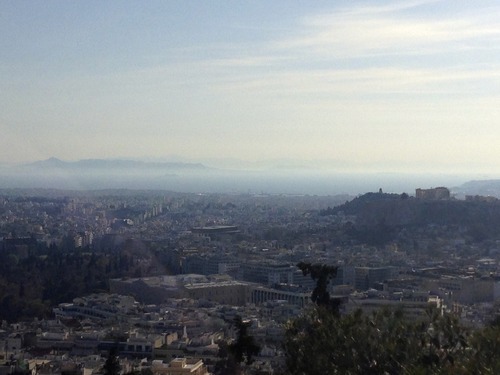
On the Sunday after returning from Thessaloniki, a few friends and I hiked Mount Lykavettos for the view, the cafe, and so that we could cross it off our bucket lists.  This is one of only a few mountains that interrupt the relatively flat city of Athens, and you can see it from almost anywhere.  The hike was short but steep and offered an amazing view.  My picture shows the Acropolis and the sea behind it.  We didn’t plan on staying for long, but at the top it was too beautiful to leave, so we ended up staying until well past sunset.  One of my favorite afternoons!

More from the field trip to Thessaloniki and northern Greece


A walk through a fish market, one of the many beautiful churches we toured, Fiona on top of the world, and three pictures from the site that claims to be the school of Aristotle where he taught Alexander the Great.

Northern Greece

Pictures from our second field trip - this time we went to northern Greece, mainly to see Thessaloniki and Pella.  The first picture is Mount Olympus, which we passed from the bus.  It’s huge!  At the port in Thessaloniki, the sky was perfectly clear, and the only thing in the sky that looked like clouds was actually the snow-capped top of Mount Olympus in the distance.  The second picture is from a small tour we took at Ambelica on the drive up to Thessaloniki - this town is very small, but it was worth the stop because it had its own kind of Rennaisance in the 18th century when they discovered that they had the resources to manufacture and trade a special color of dyed cotton.  The town educated their people in business and languages so they could trade successfully.  This painting is from the house of one of the very influential families, and it shows the port of Istanbul.  That was cool to see after revisiting Istanbul the previous weekend with my family!
Then I have a couple of pictures of the water at Thessaloniki, which is right next to a strip of nice bars and restaurants.  We had much more free time on this trip than we had in the Peloponnese, so we were able to explore this area a lot!
While we were there, Thessaloniki was hosting its annual documentary film festival, with international documentaries playing all day.  I got to see two documentaries, one on the hostage crisis in Tehran, and another on an American man who went to live with Pigmies in Africa.  I also got to go on a walk through a certain neighborhood of Thessaloniki with a CYA professor who specializes in ethnography, so I learned a bit about the population exchange between Turkey and Greece a couple of generations ago.  We also visited an art exhibit (I have a picture of it) featuring a photographer’s work on the crisis in Greece.
We spent about three days in Thessaloniki and one visiting Pella, the city where Alexander the Great and Phillip came from.  The site itself was not particularly impressive, but it’s always cool to see where these people lived!